
Welcome to MIT HAN Lab! We specialize in efficient generative AI, including large language models (LLMs), multi-modal models, and diffusion models. Today’s foundation models are remarkably powerful but prohibitively costly in terms of computation, energy, and scalability. At MIT HAN Lab, we integrate algorithm–system co-design to push the frontier of AI efficiency and performance. Our research focuses on the infrastructure of the entire AI stack — from pre-training and post-training to model compression, deployment and token factory — bridging fundamental breakthroughs with real-world applications. By rethinking how AI is designed with GPU efficiency in mind, we aim to make generative AI faster, greener, and more accessible.
PI: Prof. Song Han
Alumni: Ji Lin (OpenAI -> Meta TBD lab), Hanrui Wang (Co-founder @Eigen AI, acquired by Nebius, SVP of applied AI), Zhijian Liu (Assistant professor @UCSD; co-founder @Inco AI), Han Cai (NVIDIA Research), Haotian Tang (Google Deepmind->Meta TBD lab), Yujun Lin (NVIDIA Research -> Co-founder @Nunchux AI), Wei-Chen Wang (Co-Founder @Eigen AI, acquired by Nebius, VP of AI Inference), Wei-Ming Chen (NVIDIA), Muyang Li (Co-founder @Nunchux AI), Zhekai Zhang (Co-founder @Nunchux AI), Guangxuan Xiao (Thinking Machines Lab)
Prospective PhD students: our lab is currently full in capacity. Please do no email us regarding admissions.
Accelerating LLM and Generative AI [slides]:


Kernel Design Agents (KDA) achieves 1st place in the MoE Track, 2nd place in the DSA Track, and 3rd place in the GDN Track at the MLSys 2026 FlashInfer Full-Agent Track!
HART has been highlighted by MIT news: AI tool generates high-quality images faster than state-of-the-art approaches!
🔥⚡ We release TinyChat 2.0, the latest version with significant advancements in prefilling speed of Edge LLMs and VLMs, 1.5-1.7x faster than the previous version of TinyChat. Please refer to our blog for more details.
DistriFusion is integrated in NVIDIA's TensorRT-LLM for distributed inference on high-resolution image generation.
🔥 NVIDIA TensorRT-LLM, AMD, Google Vertex AI, Amazon Sagemaker, Intel Neural Compressor, FastChat, vLLM, HuggingFace TGI, and LMDeploy adopt AWQ to improve LLM serving efficiency. Our AWQ models on HuggingFace has received over 6 million downloads.
Congrats on graduation! Cheers on the next move: Zhijian Liu: assistant professor at UCSD, Hanrui Wang: assistant professor at UCLA, Ji Lin: OpenAI, Han Cai: NVIDIA Research, Wei-Chen Wang (postdoc): Amazon, Wei-Ming Chen (postdoc): NVIDIA.
We show SmoothQuant can enable W8A8 quantization for Llama-1/2, Falcon, Mistral, and Mixtral models with negligible loss.
We supported VILA Vision Languague Models in AWQ & TinyChat! Check our latest demos with multi-image inputs!
StreamingLLM is integrated by HPC-AI Tech SwiftInfer to support infinite input length for LLM inference.
StreamingLLM is integrated by CMU, UW, and OctoAI, enabling endless and efficient LLM generation on iPhone!
Congrats Ji Lin completed and defended his PhD thesis: "Efficient Deep Learning Computing: From TinyML to Large Language Model". Ji joined OpenAI after graduation.
AWQ is integrate by NVIDIA TensorRT-LLM, can fit Falcon-180B on a single H200GPU with INT4 AWQ, and 6.7x faster Llama-70B over A100.
🔥 AWQ is now integrated natively in Hugging Face transformers through from_pretrained. You can either load quantized models from the Hub or your own HF quantized models.
Attention Sinks, an library from community enables StreamingLLM on more Huggingface LLMs. blog.

Long-Context Transformer Models (LCTMs) are vital for real-world applications but suffer high computational costs due to attention's quadratic complexity. Block-sparse attention mitigates this by focusing computation on critical regions, yet existing methods struggle with balancing accuracy and efficiency due to costly block importance measurements. In this paper, we introduce XAttention, a plug-and-play framework that dramatically accelerates long-context inference in Transformers models using sparse attention. XAttention's key innovation is the insight that the sum of antidiagonal values (i.e., from the lower-left to upper-right) in the attention matrix provides a powerful proxy for block importance. This allows for precise identification and pruning of non-essential blocks, resulting in high sparsity and dramatically accelerated inference. Across comprehensive evaluations on demanding long-context benchmarks—including RULER and LongBench for language, VideoMME for video understanding, and VBench for video generation—XAttention achieves accuracy comparable to full attention while delivering substantial computational gains. We demonstrate up to 13.5x acceleration in attention computation. These results underscore XAttention's ability to unlock the practical potential of block sparse attention, paving the way for scalable and efficient deployment of LCTMs in real-world applications.
A plug-and-play method that uses antidiagonal sums to efficiently identify important parts of the attention matrix, achieving up to 13.5x speedup on long-context tasks with comparable accuracy to full attention.
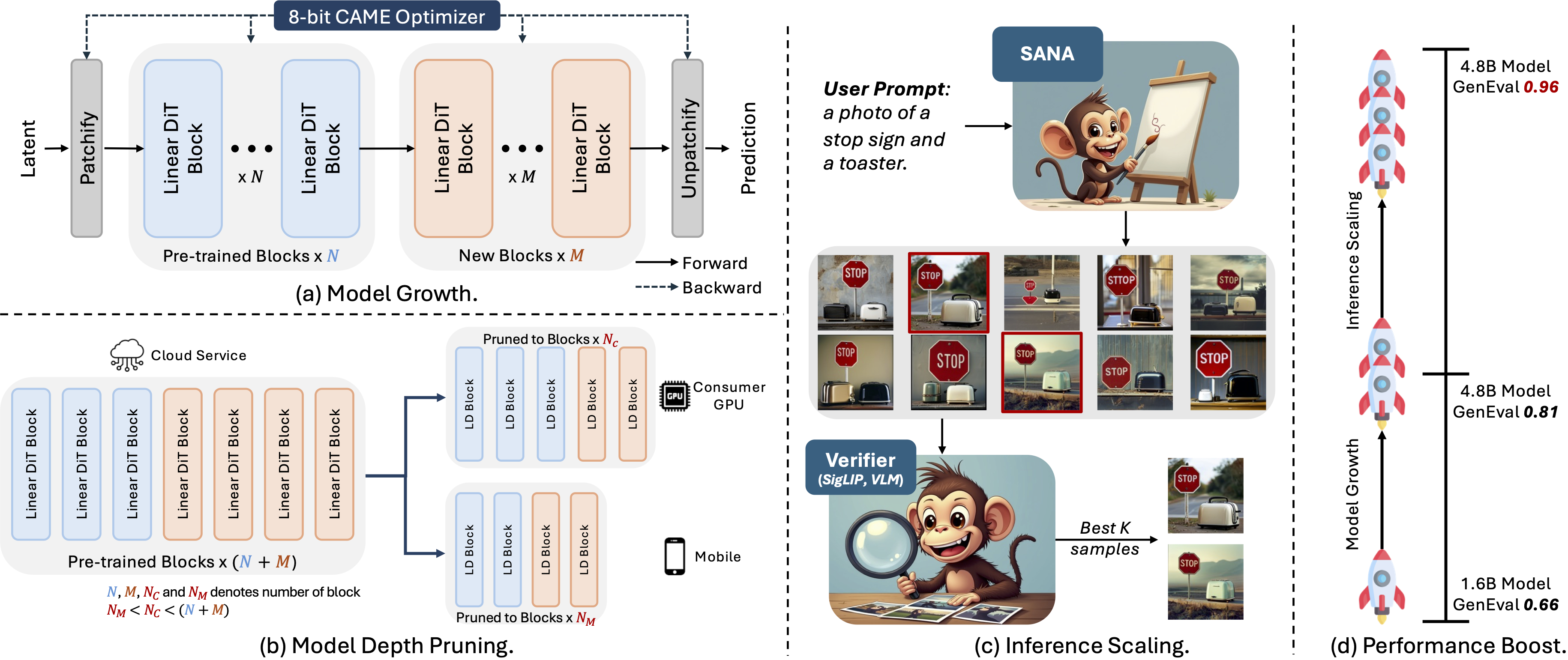
This paper presents SANA-1.5, a linear Diffusion Transformer for efficient scaling in text-to-image generation. Building upon SANA-1.0, we introduce three key innovations: (1) Efficient Training Scaling: A depth-growth paradigm that enables scaling from 1.6B to 4.8B parameters with significantly reduced computational resources, combined with a memory-efficient 8-bit optimizer. (2) Model Depth Pruning: A block importance analysis technique for efficient model compression to arbitrary sizes with minimal quality loss. (3) Inference-time Scaling: A repeated sampling strategy that trades computation for model capacity, enabling smaller models to match larger model quality at inference time. Through these strategies, SANA-1.5 achieves a text-image alignment score of 0.81 on GenEval, which can be further improved to 0.96 through inference scaling, establishing a new SoTA on GenEval benchmark. These innovations enable efficient model scaling across different compute budgets while maintaining high quality, making high-quality image generation more accessible. Our code and pre-trained models will be released.
SANA-1.5 explores efficient training scaling and inference scaling for diffusion models; Deployable on laptop GPU; Top-notch GenEval & DPGBench results.

Large language models (LLMs) have shown remarkable potential in processing long sequences, yet efficiently serving these long-context models remains challenging due to the quadratic computational complexity of attention in the prefilling stage and the large memory footprint of the KV cache in the decoding stage. To address these issues, we introduce LServe, an efficient system that accelerates long-sequence LLM serving via unified sparse attention. This method unifies different hardware-friendly, structured sparsity patterns for both prefilling and decoding attention into a single framework, where computations on less important tokens are skipped block-wise. LServe demonstrates the compatibility of static and dynamic sparsity in long-context LLM attention. This design enables multiplicative speedups by combining these optimizations. Specifically, we convert half of the attention heads to nearly free streaming heads in both the prefilling and decoding stages. Additionally, we find that only a constant number of KV pages is required to preserve long-context capabilities, irrespective of context length. We then design a hierarchical KV page selection policy that dynamically prunes KV pages based on query-centric similarity. For Llama-3-8B, LServe accelerates LLM prefilling by an average of 2.4x and decoding by up to 3.3x over the state-of-the-art serving systems, maintaining long-context accuracy.
LServe accelerates long-sequence LLM serving with unified sparse attention for both prefilling and decoding, achieving up to 3.3× speedup over state-of-the-art solution without sacrificing accuracy.

Quantization can accelerate large language model (LLM) inference. Going beyond INT8 quantization, the research community is actively exploring even lower precision, such as INT4. Nonetheless, state-of-the-art INT4 quantization techniques only accelerate low-batch, edge LLM inference, failing to deliver performance gains in large-batch, cloud-based LLM serving. We uncover a critical issue: existing INT4 quantization methods suffer from significant runtime overhead (20-90%) when dequantizing either weights or partial sums on GPUs. To address this challenge, we introduce QoQ, a W4A8KV4 quantization algorithm with 4-bit weight, 8-bit activation, and 4-bit KV cache. QoQ stands for quattuor-octo-quattuor, which represents 4-8-4 in Latin. QoQ is implemented by the QServe inference library that achieves measured speedup. The key insight driving QServe is that the efficiency of LLM serving on GPUs is critically influenced by operations on low-throughput CUDA cores. Building upon this insight, in QoQ algorithm, we introduce progressive quantization that can allow low dequantization overhead in W4A8 GEMM. Additionally, we develop SmoothAttention to effectively mitigate the accuracy degradation incurred by 4-bit KV quantization. In the QServe system, we perform compute-aware weight reordering and take advantage of register-level parallelism to reduce dequantization latency. We also make fused attention memory-bound, harnessing the performance gain brought by KV4 quantization. As a result, QServe improves the maximum achievable serving throughput of Llama-3-8B by 1.2× on A100, 1.4× on L40S; and Qwen1.5-72B by 2.4× on A100, 3.5× on L40S, compared to TensorRT-LLM. Remarkably, QServe on L40S GPU can achieve even higher throughput than TensorRT-LLM on A100. Thus, QServe effectively reduces the dollar cost of LLM serving by 3×.
QServe accelerates large-scale LLM serving on GPUs with QoQ (W4A8KV4) quantization, boosting the generation throughputs by up to 3x over the state-of-the-art solution.
We actively collaborate with industry partners on efficient AI, model compression and acceleration. Our research has influenced and landed in many industrial products: Intel OpenVino, Intel Neural Network Distiller, Intel Neural Compressor, Apple Neural Engine, NVIDIA Sparse Tensor Core, NVIDIA TensorRT LLM, AMD-Xilinx Vitis AI, Qualcomm AI Model Efficiency Toolkit (AIMET), Amazon AutoGluon, Facebook PyTorch, Microsoft NNI, SONY Neural Architecture Search Library, SONY Model Compression Toolkit, ADI MAX78000/MAX78002 Model Training and Synthesis Tool.


