
Welcome to MIT HAN Lab! We specialize in efficient generative AI, including large language models (LLMs), multi-modal models, and diffusion models. Today’s foundation models are remarkably powerful but prohibitively costly in terms of computation, energy, and scalability. At MIT HAN Lab, we integrate algorithm–system co-design to push the frontier of AI efficiency and performance. Our research focuses on the infrastructure of the entire AI stack — from pre-training and post-training to model compression, deployment and token factory — bridging fundamental breakthroughs with real-world applications. By rethinking how AI is designed with GPU efficiency in mind, we aim to make generative AI faster, greener, and more accessible.
PI: Prof. Song Han
Alumni: Ji Lin (OpenAI -> Meta TBD lab), Hanrui Wang (Co-founder @Eigen AI, acquired by Nebius, SVP of applied AI), Zhijian Liu (Assistant professor @UCSD; co-founder @Inco AI), Han Cai (NVIDIA Research), Haotian Tang (Google Deepmind->Meta TBD lab), Yujun Lin (NVIDIA Research -> Co-founder @Nunchux AI), Wei-Chen Wang (Co-Founder @Eigen AI, acquired by Nebius, VP of AI Inference), Wei-Ming Chen (NVIDIA), Muyang Li (Co-founder @Nunchux AI), Zhekai Zhang (Co-founder @Nunchux AI), Guangxuan Xiao (Thinking Machines Lab)
Accelerating LLM and Generative AI [slides]:


Kernel Design Agents (KDA) achieves 1st place in the MoE Track, 2nd place in the DSA Track, and 3rd place in the GDN Track at the MLSys 2026 FlashInfer Full-Agent Track!
HART has been highlighted by MIT news: AI tool generates high-quality images faster than state-of-the-art approaches!
🔥⚡ We release TinyChat 2.0, the latest version with significant advancements in prefilling speed of Edge LLMs and VLMs, 1.5-1.7x faster than the previous version of TinyChat. Please refer to our blog for more details.
DistriFusion is integrated in NVIDIA's TensorRT-LLM for distributed inference on high-resolution image generation.
🔥 NVIDIA TensorRT-LLM, AMD, Google Vertex AI, Amazon Sagemaker, Intel Neural Compressor, FastChat, vLLM, HuggingFace TGI, and LMDeploy adopt AWQ to improve LLM serving efficiency. Our AWQ models on HuggingFace has received over 6 million downloads.
Congrats on graduation! Cheers on the next move: Zhijian Liu: assistant professor at UCSD, Hanrui Wang: assistant professor at UCLA, Ji Lin: OpenAI, Han Cai: NVIDIA Research, Wei-Chen Wang (postdoc): Amazon, Wei-Ming Chen (postdoc): NVIDIA.
We show SmoothQuant can enable W8A8 quantization for Llama-1/2, Falcon, Mistral, and Mixtral models with negligible loss.
We supported VILA Vision Languague Models in AWQ & TinyChat! Check our latest demos with multi-image inputs!
StreamingLLM is integrated by HPC-AI Tech SwiftInfer to support infinite input length for LLM inference.
StreamingLLM is integrated by CMU, UW, and OctoAI, enabling endless and efficient LLM generation on iPhone!
Congrats Ji Lin completed and defended his PhD thesis: "Efficient Deep Learning Computing: From TinyML to Large Language Model". Ji joined OpenAI after graduation.
AWQ is integrate by NVIDIA TensorRT-LLM, can fit Falcon-180B on a single H200GPU with INT4 AWQ, and 6.7x faster Llama-70B over A100.
🔥 AWQ is now integrated natively in Hugging Face transformers through from_pretrained. You can either load quantized models from the Hub or your own HF quantized models.
Attention Sinks, an library from community enables StreamingLLM on more Huggingface LLMs. blog.
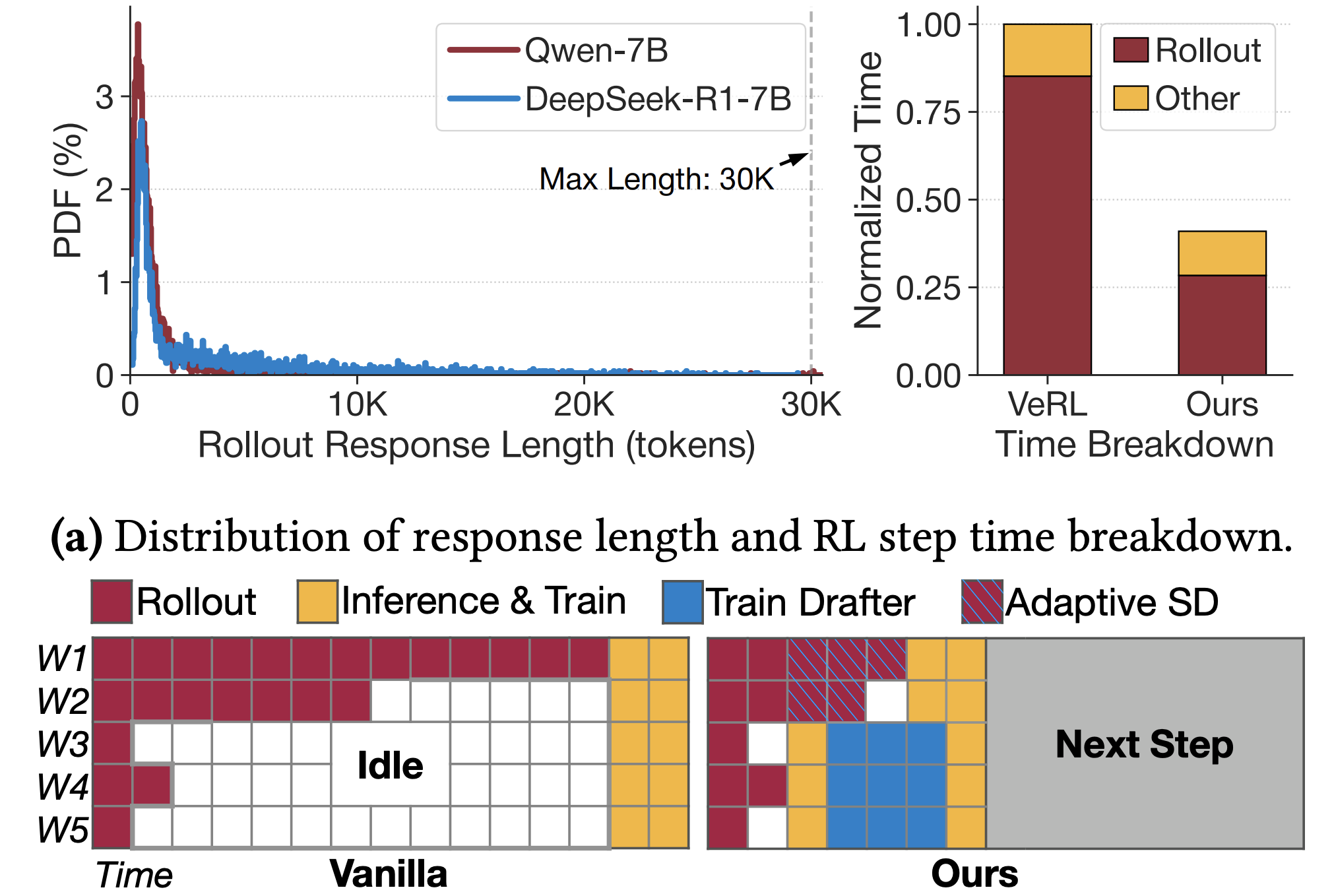
The emergence of Large Language Models (LLMs) with strong reasoning capabilities marks a significant milestone, unlocking new frontiers in complex problem-solving. However, training these reasoning models, typically using Reinforcement Learning (RL), encounters critical efficiency bottlenecks: response generation during RL training exhibits a persistent long-tail distribution, where a few very long responses dominate execution time, wasting resources and inflating costs. To address this, we propose TLT, a system that accelerates reasoning RL training losslessly by integrating adaptive speculative decoding. Applying speculative decoding in RL is challenging due to the dynamic workloads, evolving target model, and draft model training overhead. TLT overcomes these obstacles with two synergistic components: (1) Adaptive Drafter, a lightweight draft model trained continuously on idle GPUs during long-tail generation to maintain alignment with the target model at no extra cost; and (2) Adaptive Rollout Engine, which maintains a memory efficient pool of pre-captured CUDAGraphs and adaptively select suitable SD strategies for each input batch. Evaluations demonstrate that TLT achieves over 1.7× end-to-end RL training speedup over state-of-the-art systems, preserves the model accuracy, and yields a high-quality draft model as a free byproduct suitable for efficient deployment.
TLT is a lossless acceleration framework for reasoning-oriented LLM RL training, introducing adaptive speculative decoding to eliminate long-tail generation bottlenecks. It achieves over 1.7× end-to-end speedup while fully preserving model quality and producing a high-quality draft model for efficient deployment.

We introduce a full-stack framework that scales up reasoning in vision-language models (VLMs) to long videos, leveraging reinforcement learning. We address the unique challenges of long video reasoning by integrating three critical components: (1) a large-scale dataset, LongVideo-Reason, comprising 104K long video QA pairs with high-quality reasoning annotations across diverse domains such as sports, games, and vlogs; (2) a two-stage training pipeline that extends VLMs with chain-of-thought supervised fine-tuning (CoT-SFT) and reinforcement learning (RL); and (3) a training infrastructure for long video RL, named Multi-modal Reinforcement Sequence Parallelism (MR-SP), which incorporates sequence parallelism and a vLLM-based engine tailored for long video, using cached video embeddings for efficient rollout and prefilling. In our experiments, LongVILA-R1-7B achieves strong performance on video benchmarks, reaching 65.1% and 71.1% accuracy on VideoMME without and with subtitles, respectively, and consistently outperforming LongVILA-7B across multiple benchmarks. Moreover, LongVILA-R1-7B supports processing up to 8,192 video frames per video, and configurable FPS settings. Notably, our MR-SP system achieves up to 2.1x speedup on long video RL training. In addition, we release our training system for public availability that supports RL training on various modalities (video, text, and audio), various models (VILA and Qwen series), and even image and video generation models. On a single A100 node (8 GPUs), it supports RL training on hour-long videos (e.g., 3,600 frames).
Long-RL enables RL on hour-long videos on a single A100; LongVILA-R1-7B supports 8,192 frames and scores 71.1% on VideoMME with subtitles.

Recent advances in diffusion models have enabled high-quality video generation, but the additional temporal dimension significantly increases computational costs, making training and inference on long videos prohibitively expensive. In this paper, we identify a phenomenon we term Spatiotemporal Energy Decay in video diffusion models: post-softmax attention scores diminish as spatial and temporal distance between tokens increase, akin to the physical decay of signal or waves over space and time in nature. Motivated by this, we propose Radial Attention, a scalable sparse attention mechanism with O(nlogn) complexity that translates energy decay into exponentially decaying compute density, which is significantly more efficient than standard O(n2) dense attention and more expressive than linear attention. Specifically, Radial Attention employs a simple, static attention mask where each token attends to spatially nearby tokens, with the attention window size shrinking with temporal distance. Moreover, it allows pre-trained video diffusion models to extend their generation length with efficient LoRA-based fine-tuning. Extensive experiments show that Radial Attention maintains video quality across Wan2.1-14B, HunyuanVideo, and Mochi 1, achieving up to a 1.9× speedup over the original dense attention. With minimal tuning, it enables video generation up to 4× longer while reducing training costs by up to 4.4× compared to direct fine-tuning and accelerating inference by up to 3.7× compared to dense attention inference.
A O(nlogn) Sparse Attention Mask for Long Video Generation
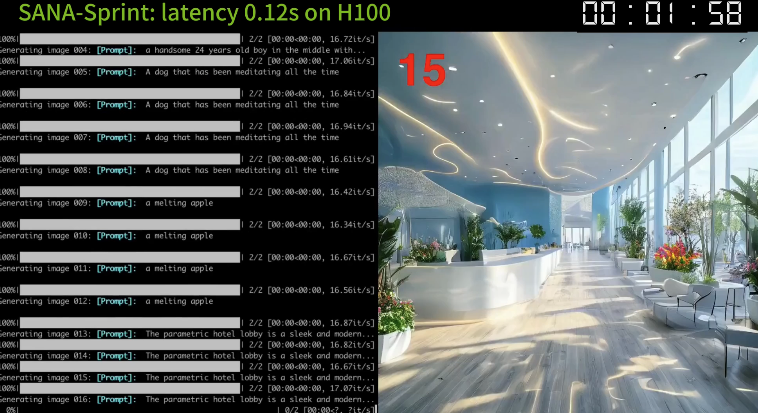
This paper presents SANA-Sprint, an efficient diffusion model for ultra-fast text-to-image (T2I) generation. SANA-Sprint is built on a pre-trained foundation model and augmented with hybrid distillation, dramatically reducing inference steps from 20 to 1-4. We introduce three key innovations: (1) We propose a training-free approach that transforms a pre-trained flow-matching model for continuous-time consistency distillation (sCM), eliminating costly training from scratch and achieving high training efficiency. Our hybrid distillation strategy combines sCM with latent adversarial distillation (LADD): sCM ensures alignment with the teacher model, while LADD enhances single-step generation fidelity. (2) SANA-Sprint is a unified step-adaptive model that achieves high-quality generation in 1-4 steps, eliminating step-specific training and improving efficiency. (3) We integrate ControlNet with SANA-Sprint for real-time interactive image generation, enabling instant visual feedback for user interaction. SANA-Sprint establishes a new Pareto frontier in speed-quality tradeoffs, achieving state-of-the-art performance with 7.59 FID and 0.74 GenEval in only 1 step — outperforming FLUX-schnell (7.94 FID / 0.71 GenEval) while being 10× faster (0.1s vs 1.1s on H100). It also achieves 0.1s (T2I) and 0.25s (ControlNet) latency for 1024×1024 images on H100, and 0.31s (T2I) on an RTX 4090, showcasing its exceptional efficiency and potential for AI-powered consumer applications (AIPC). Code and pre-trained models will be open-sourced.
SANA-Sprint is a one-step distilled diffusion model enabling real-time generation; Deployable on laptop GPU; Top-notch GenEval & DPGBench results.
We actively collaborate with industry partners on efficient AI, model compression and acceleration. Our research has influenced and landed in many industrial products: Intel OpenVino, Intel Neural Network Distiller, Intel Neural Compressor, Apple Neural Engine, NVIDIA Sparse Tensor Core, NVIDIA TensorRT LLM, AMD-Xilinx Vitis AI, Qualcomm AI Model Efficiency Toolkit (AIMET), Amazon AutoGluon, Facebook PyTorch, Microsoft NNI, SONY Neural Architecture Search Library, SONY Model Compression Toolkit, ADI MAX78000/MAX78002 Model Training and Synthesis Tool.


