
Welcome to MIT HAN Lab! We specialize in efficient generative AI, including large language models (LLMs), multi-modal models, and diffusion models. Today’s foundation models are remarkably powerful but prohibitively costly in terms of computation, energy, and scalability. At MIT HAN Lab, we integrate algorithm–system co-design to push the frontier of AI efficiency and performance. Our research focuses on the infrastructure of the entire AI stack — from pre-training and post-training to model compression, deployment and token factory — bridging fundamental breakthroughs with real-world applications. By rethinking how AI is designed with GPU efficiency in mind, we aim to make generative AI faster, greener, and more accessible.
PI: Prof. Song Han
Alumni: Ji Lin (OpenAI -> Meta TBD lab), Hanrui Wang (Co-founder @Eigen AI, acquired by Nebius, SVP of applied AI), Zhijian Liu (Assistant professor @UCSD; co-founder @Inco AI), Han Cai (NVIDIA Research), Haotian Tang (Google Deepmind->Meta TBD lab), Yujun Lin (NVIDIA Research -> Co-founder @Nunchux AI), Wei-Chen Wang (Co-Founder @Eigen AI, acquired by Nebius, VP of AI Inference), Wei-Ming Chen (NVIDIA), Muyang Li (Co-founder @Nunchux AI), Zhekai Zhang (Co-founder @Nunchux AI), Guangxuan Xiao (Thinking Machines Lab)
Accelerating LLM and Generative AI [slides]:


Kernel Design Agents (KDA) achieves 1st place in the MoE Track, 2nd place in the DSA Track, and 3rd place in the GDN Track at the MLSys 2026 FlashInfer Full-Agent Track!
HART has been highlighted by MIT news: AI tool generates high-quality images faster than state-of-the-art approaches!
🔥⚡ We release TinyChat 2.0, the latest version with significant advancements in prefilling speed of Edge LLMs and VLMs, 1.5-1.7x faster than the previous version of TinyChat. Please refer to our blog for more details.
DistriFusion is integrated in NVIDIA's TensorRT-LLM for distributed inference on high-resolution image generation.
🔥 NVIDIA TensorRT-LLM, AMD, Google Vertex AI, Amazon Sagemaker, Intel Neural Compressor, FastChat, vLLM, HuggingFace TGI, and LMDeploy adopt AWQ to improve LLM serving efficiency. Our AWQ models on HuggingFace has received over 6 million downloads.
Congrats on graduation! Cheers on the next move: Zhijian Liu: assistant professor at UCSD, Hanrui Wang: assistant professor at UCLA, Ji Lin: OpenAI, Han Cai: NVIDIA Research, Wei-Chen Wang (postdoc): Amazon, Wei-Ming Chen (postdoc): NVIDIA.
We show SmoothQuant can enable W8A8 quantization for Llama-1/2, Falcon, Mistral, and Mixtral models with negligible loss.
We supported VILA Vision Languague Models in AWQ & TinyChat! Check our latest demos with multi-image inputs!
StreamingLLM is integrated by HPC-AI Tech SwiftInfer to support infinite input length for LLM inference.
StreamingLLM is integrated by CMU, UW, and OctoAI, enabling endless and efficient LLM generation on iPhone!
Congrats Ji Lin completed and defended his PhD thesis: "Efficient Deep Learning Computing: From TinyML to Large Language Model". Ji joined OpenAI after graduation.
AWQ is integrate by NVIDIA TensorRT-LLM, can fit Falcon-180B on a single H200GPU with INT4 AWQ, and 6.7x faster Llama-70B over A100.
🔥 AWQ is now integrated natively in Hugging Face transformers through from_pretrained. You can either load quantized models from the Hub or your own HF quantized models.
Attention Sinks, an library from community enables StreamingLLM on more Huggingface LLMs. blog.

We propose QeRL, a Quantization-enhanced Reinforcement Learning framework for large language models (LLMs). While RL is essential for LLMs' reasoning capabilities, it is resource-intensive, requiring substantial GPU memory and long rollout durations. QeRL addresses these issues by combining NVFP4 quantization with Low-Rank Adaptation (LoRA), accelerating rollout phase of RL while reducing memory overhead. Beyond efficiency, our findings show that quantization noise increases policy entropy, enhancing exploration, and enabling the discovery of better strategies during RL. To further optimize exploration, QeRL introduces an Adaptive Quantization Noise (AQN) mechanism, which dynamically adjusts noise during training. Experiments demonstrate that QeRL delivers over 1.5 times speedup in the rollout phase. Moreover, this is the first framework to enable RL training of a 32B LLM on a single H100 80GB GPU, while delivering overall speedups for RL training. It also achieves faster reward growth and higher final accuracy than 16-bit LoRA and QLoRA, while matching the performance of full-parameter fine-tuning on mathematical benchmarks such as GSM8K (90.8%) and MATH 500 (77.4%) in the 7B model. These results establish QeRL as an efficient and effective framework for RL training in LLMs.
QeRL is a framework that accelerates LLM training by combining NVFP4 quantization with LoRA. It reduces memory overhead, allows 32B model training on a single H100 GPU, and improves performance by leveraging quantization noise to
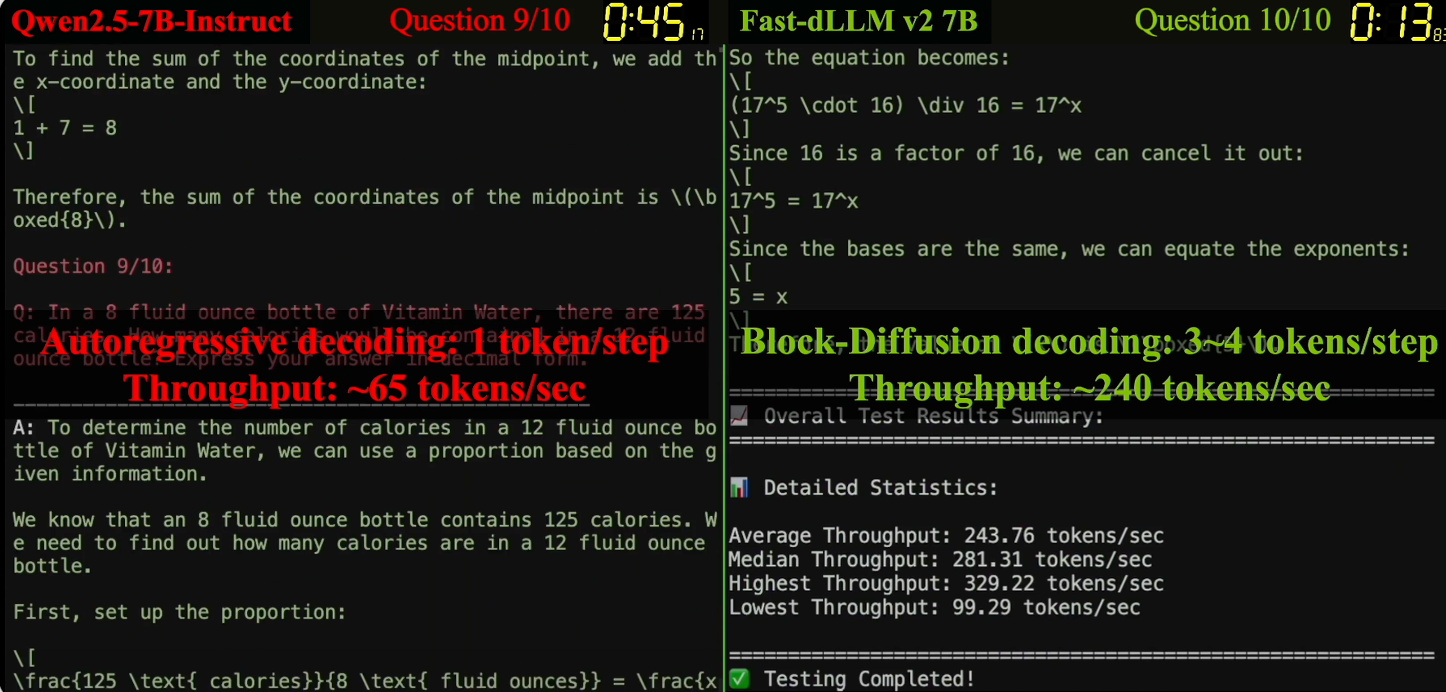
Autoregressive (AR) large language models (LLMs) have achieved remarkable performance across a wide range of natural language tasks, yet their inherent sequential decoding limits inference efficiency. In this work, we propose Fast-dLLM v2, a carefully designed block diffusion language model (dLLM) that efficiently adapts pretrained AR models into dLLMs for parallel text generation, requiring only approximately 1B tokens of fine-tuning. This represents a 500x reduction in training data compared to full-attention diffusion LLMs such as Dream (580B tokens), while preserving the original model's performance. Our approach introduces a novel training recipe that combines a block diffusion mechanism with a complementary attention mask, enabling blockwise bidirectional context modeling without sacrificing AR training objectives. To further accelerate decoding, we design a hierarchical caching mechanism: a block-level cache that stores historical context representations across blocks, and a sub-block cache that enables efficient parallel generation within partially decoded blocks. Coupled with our parallel decoding pipeline, Fast-dLLM v2 achieves up to 2.5x speedup over standard AR decoding without compromising generation quality. Extensive experiments across diverse benchmarks demonstrate that Fast-dLLM v2 matches or surpasses AR baselines in accuracy, while delivering state-of-the-art efficiency among dLLMs - marking a significant step toward the practical deployment of fast and accurate LLMs.
Our approach introduces a novel training recipe that combines a block diffusion mechanism with a complementary attention mask, enabling blockwise bidirectional context modeling without sacrificing AR training objectives.
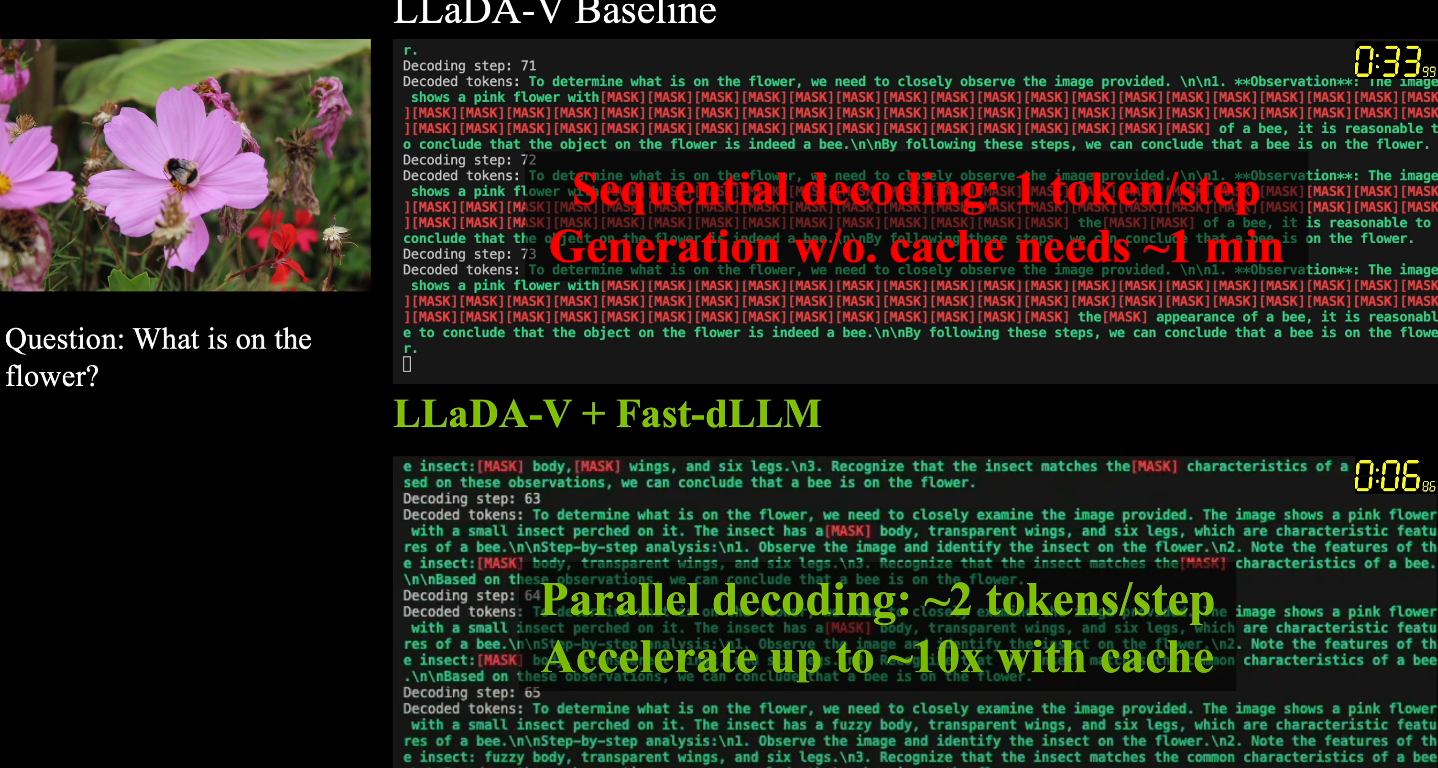
Diffusion-based large language models (Diffusion LLMs) have shown promise for non-autoregressive text generation with parallel decoding capabilities. However, the practical inference speed of open-sourced Diffusion LLMs often lags behind autoregressive models due to the lack of Key-Value (KV) Cache and quality degradation when decoding multiple tokens simultaneously. To bridge this gap, we introduce a novel block-wise approximate KV Cache mechanism tailored for bidirectional diffusion models, enabling cache reuse with negligible performance drop. Additionally, we identify the root cause of generation quality degradation in parallel decoding as the disruption of token dependencies under the conditional independence assumption. To address this, we propose a confidence-aware parallel decoding strategy that selectively decodes tokens exceeding a confidence threshold, mitigating dependency violations and maintaining generation quality. Experimental results on LLaDA and Dream models across multiple LLM benchmarks demonstrate up to 27.6x throughput improvement with minimal accuracy loss, closing the performance gap with autoregressive models and paving the way for practical deployment of Diffusion LLMs.
We introduce a novel block-wise approximate KV Cache mechanism tailored for bidirectional diffusion models, enabling cache reuse with negligible performance drop.
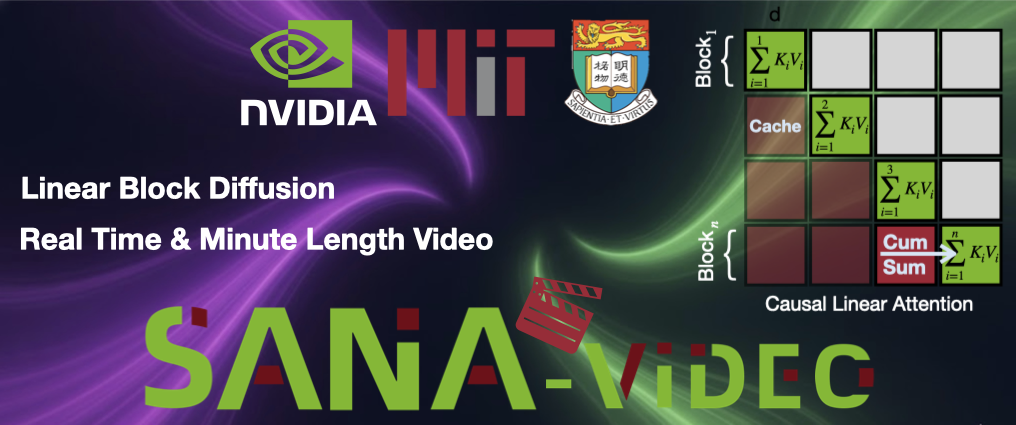
We introduce SANA-Video, a small diffusion model that can efficiently generate videos up to 720×1280 resolution and minute-length duration. SANA-Video synthesizes high-resolution, high-quality and long videos with strong text-video alignment at a remarkably fast speed, deployable on RTX 5090 GPU. Two core designs ensure our efficient, effective and long video generation: (1) Linear DiT: We leverage linear attention as the core operation, which is more efficient than vanilla attention given the large number of tokens processed in video generation. (2) Constant-Memory KV cache for Block Linear Attention: we design block-wise autoregressive approach for long video generation by employing a constant-memory state, derived from the cumulative properties of linear attention. This KV cache provides the Linear DiT with global context at a fixed memory cost, eliminating the need for a traditional KV cache and enabling efficient, minute-long video generation. In addition, we explore effective data filters and model training strategies, narrowing the training cost to 12 days on 64 H100 GPUs, which is only 1% of the cost of MovieGen. Given its low cost, SANA-Video achieves competitive performance compared to modern state-of-the-art small diffusion models (e.g., Wan 2.1-1.3B and SkyReel-V2-1.3B) while being 16× faster in measured latency. Moreover, SANA-Video can be deployed on RTX 5090 GPUs with NVFP4 precision, accelerating the inference speed of generating a 5-second 720p video from 71s to 29s (2.4× speedup). In summary, SANA-Video enables low-cost, high-quality video generation. Code and model will be publicly released.
SANA-Video is a fast, efficient diffusion model that generates high-quality, minute-long videos upto 720×1280 resolution. It uses linear attention and a constant-memory KV cache to handle long videos with fixed memory, enabling real-time (27PFS) 1 mintue video generation.
We actively collaborate with industry partners on efficient AI, model compression and acceleration. Our research has influenced and landed in many industrial products: Intel OpenVino, Intel Neural Network Distiller, Intel Neural Compressor, Apple Neural Engine, NVIDIA Sparse Tensor Core, NVIDIA TensorRT LLM, AMD-Xilinx Vitis AI, Qualcomm AI Model Efficiency Toolkit (AIMET), Amazon AutoGluon, Facebook PyTorch, Microsoft NNI, SONY Neural Architecture Search Library, SONY Model Compression Toolkit, ADI MAX78000/MAX78002 Model Training and Synthesis Tool.


