
Welcome to MIT HAN Lab! We specialize in efficient generative AI, including large language models (LLMs), multi-modal models, and diffusion models. Today’s foundation models are remarkably powerful but prohibitively costly in terms of computation, energy, and scalability. At MIT HAN Lab, we integrate algorithm–system co-design to push the frontier of AI efficiency and performance. Our research focuses on the infrastructure of the entire AI stack — from pre-training and post-training to model compression, deployment and token factory — bridging fundamental breakthroughs with real-world applications. By rethinking how AI is designed with GPU efficiency in mind, we aim to make generative AI faster, greener, and more accessible.
PI: Prof. Song Han
Alumni: Ji Lin (OpenAI -> Meta TBD lab), Hanrui Wang (Co-founder @Eigen AI, acquired by Nebius, SVP of applied AI), Zhijian Liu (Assistant professor @UCSD; co-founder @Inco AI), Han Cai (NVIDIA Research), Haotian Tang (Google Deepmind->Meta TBD lab), Yujun Lin (NVIDIA Research -> Co-founder @Nunchux AI), Wei-Chen Wang (Co-Founder @Eigen AI, acquired by Nebius, VP of AI Inference), Wei-Ming Chen (NVIDIA), Muyang Li (Co-founder @Nunchux AI), Zhekai Zhang (Co-founder @Nunchux AI), Guangxuan Xiao (Thinking Machines Lab)
Accelerating LLM and Generative AI [slides]:


Kernel Design Agents (KDA) achieves 1st place in the MoE Track, 2nd place in the DSA Track, and 3rd place in the GDN Track at the MLSys 2026 FlashInfer Full-Agent Track!
HART has been highlighted by MIT news: AI tool generates high-quality images faster than state-of-the-art approaches!
🔥⚡ We release TinyChat 2.0, the latest version with significant advancements in prefilling speed of Edge LLMs and VLMs, 1.5-1.7x faster than the previous version of TinyChat. Please refer to our blog for more details.
DistriFusion is integrated in NVIDIA's TensorRT-LLM for distributed inference on high-resolution image generation.
🔥 NVIDIA TensorRT-LLM, AMD, Google Vertex AI, Amazon Sagemaker, Intel Neural Compressor, FastChat, vLLM, HuggingFace TGI, and LMDeploy adopt AWQ to improve LLM serving efficiency. Our AWQ models on HuggingFace has received over 6 million downloads.
Congrats on graduation! Cheers on the next move: Zhijian Liu: assistant professor at UCSD, Hanrui Wang: assistant professor at UCLA, Ji Lin: OpenAI, Han Cai: NVIDIA Research, Wei-Chen Wang (postdoc): Amazon, Wei-Ming Chen (postdoc): NVIDIA.
We show SmoothQuant can enable W8A8 quantization for Llama-1/2, Falcon, Mistral, and Mixtral models with negligible loss.
We supported VILA Vision Languague Models in AWQ & TinyChat! Check our latest demos with multi-image inputs!
StreamingLLM is integrated by HPC-AI Tech SwiftInfer to support infinite input length for LLM inference.
StreamingLLM is integrated by CMU, UW, and OctoAI, enabling endless and efficient LLM generation on iPhone!
Congrats Ji Lin completed and defended his PhD thesis: "Efficient Deep Learning Computing: From TinyML to Large Language Model". Ji joined OpenAI after graduation.
AWQ is integrate by NVIDIA TensorRT-LLM, can fit Falcon-180B on a single H200GPU with INT4 AWQ, and 6.7x faster Llama-70B over A100.
🔥 AWQ is now integrated natively in Hugging Face transformers through from_pretrained. You can either load quantized models from the Hub or your own HF quantized models.
Attention Sinks, an library from community enables StreamingLLM on more Huggingface LLMs. blog.
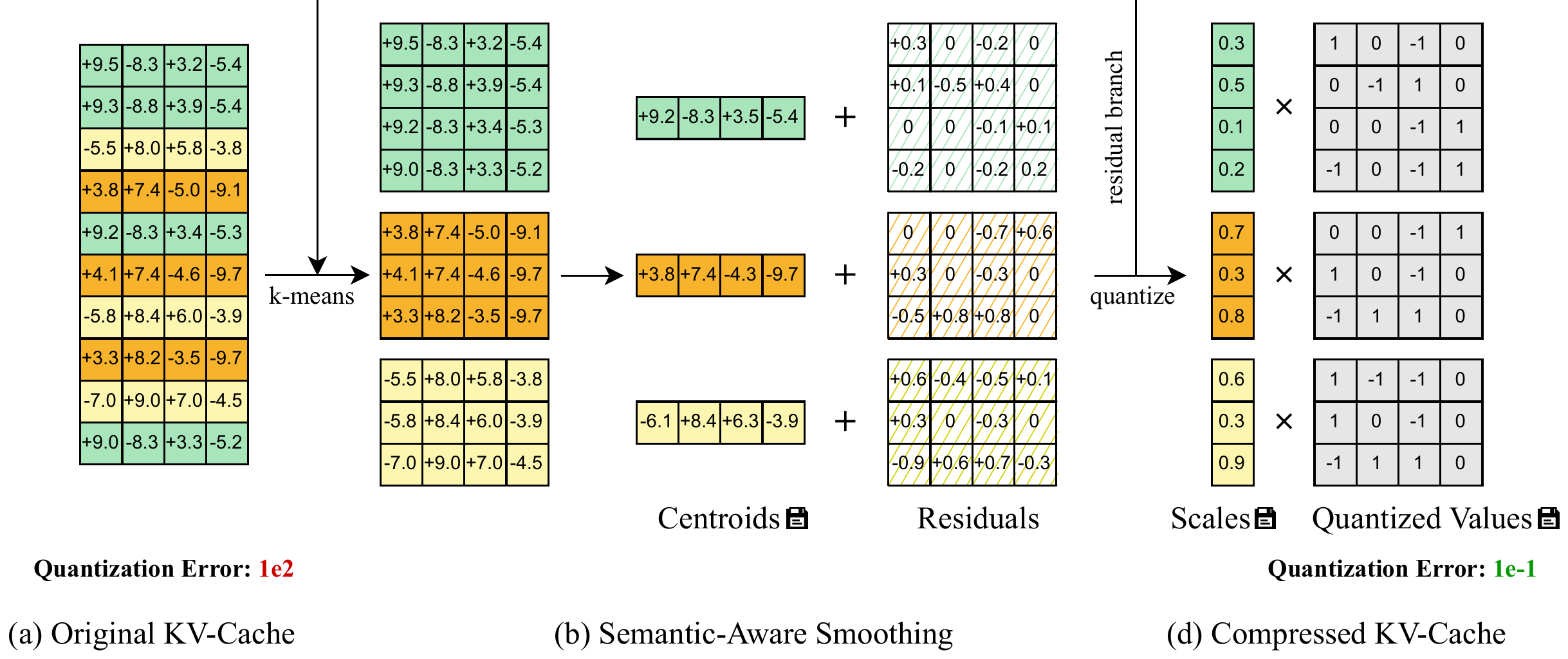
Despite rapid progress in auto-regressive video diffusion, we identify an emerging system–algorithm bottleneck that limits both deployability and capability: KV-cache memory. In auto-regressive video generation models, the KV-cache grows with history and rapidly dominates GPU memory (often ≥ 30 GB), blocking deployment on widely available hardware. More importantly, memory-bounded KV budgets force small working memory, which directly degrades long-horizon consistency in identity, layout, and motion, etc. To bridge this gap, we present Quant VideoGen (QVG), a training-free KV-cache quantization framework for auto-regressive video diffusion model. QVG exploits video’s spatiotemporal redundancy through Semantic-Aware Smoothing to produce low-magnitude, quantization-friendly residuals. QVG further propose Progressive Residual Quantization, a coarse-to-fine multi-stage scheme that reduces quantization error while enabling a smooth quality–memory trade-off. Across LongCat-Video, HY-WorldPlay, and Self-Forcing, QVG establishes a new Pareto quality-memory frontier, reducing KV memory by up to 7.0× with < 4% end-to-end latency overhead and significantly better quality over baselines.
A training-free KV-cache quantization framework for auto-regressive video diffusion, cutting KV memory by up to 7.0× with under 4% end-to-end latency overhead.
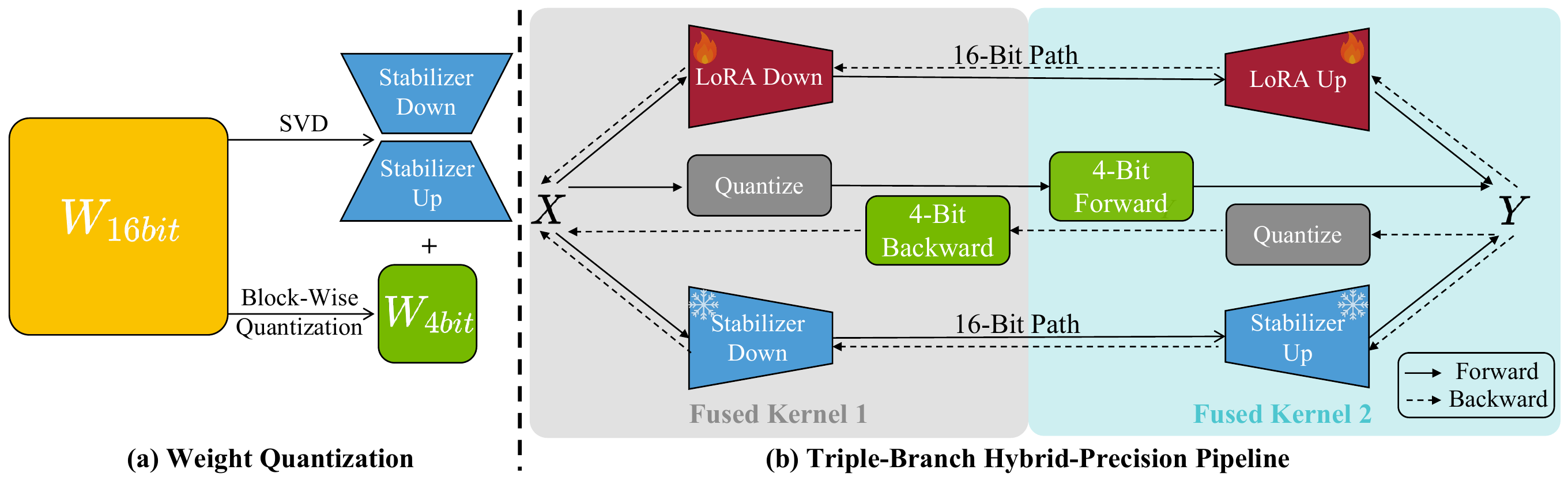
Diffusion models have become a dominant paradigm for high-quality generative modeling, while post-training is essential for adapting them to diverse downstream applications. However, post-training of large diffusion models is still challenging due to the prohibitive memory footprints and slow training speed, which existing parameter-efficient fine-tuning methods only partially address. To overcome these limitations, we propose FourTune, an efficient post-training framework for diffusion models based on an end-to-end W4A4G4 paradigm. FourTune introduces a triple-branch hybrid pipeline that augments the standard LoRA architecture with a frozen numerical stabilizer to isolate quantization-sensitive outliers, enabling stable training under native 4-bit computation. In addition, FourTune employs hardware-efficient block-wise quantization and customized fused kernels to support efficient quantized backpropagation and reduce memory bandwidth overhead. Across customization, reinforcement learning, and distillation tasks, FourTune matches the quality of full-precision fine-tuning. On FLUX.1-dev (12B), FourTune reduces memory overhead by 2.25× and increases end-to-end training throughput by 2.27× compared to BF16 LoRA.
An end-to-end W4A4G4 post-training framework for diffusion models, cutting memory 2.25× and boosting training throughput 2.27× over BF16 LoRA on FLUX.1-dev.

Vision-Language-Action models (VLAs) are becoming increasingly capable across diverse robotic tasks. However, their real-world deployment remains slow and inefficient: demonstration videos are often sped up by 5-10x to appear smooth, with noticeable action stalls and delayed reactions to environmental changes. Asynchronous inference offers a promising solution to achieve continuous and low-latency control by enabling robots to execute actions and perform inference simultaneously. However, because the robot and environment continue to evolve during inference, a temporal misalignment arises between the prediction and execution intervals. This leads to significant action instability, while existing methods either degrade accuracy or introduce runtime overhead to mitigate it. We propose VLASH, a general asynchronous inference framework for VLAs that delivers smooth, accurate, and fast reaction control without additional overhead or architectural changes. VLASH estimates the future execution-time state by rolling the robot state forward with the previously generated action chunk, thereby bridging the gap between prediction and execution. Experiments show that VLASH achieves up to 2.03x speedup and reduces reaction latency by up to 17.4x compared to synchronous inference while fully preserving the original accuracy. Moreover, it empowers VLAs to handle fast-reaction, high-precision tasks such as playing ping-pong and playing whack-a-mole, where traditional synchronous inference fails.
VLASH is a general asynchronous inference framework for VLAs that delivers smooth, accurate, and low-latency control with no overhead or architectural changes. By rolling the robot state forward with the previous action chunk, it achieves up to 2.03× speedup and 17.4× lower reaction latency while fully preserving accuracy.
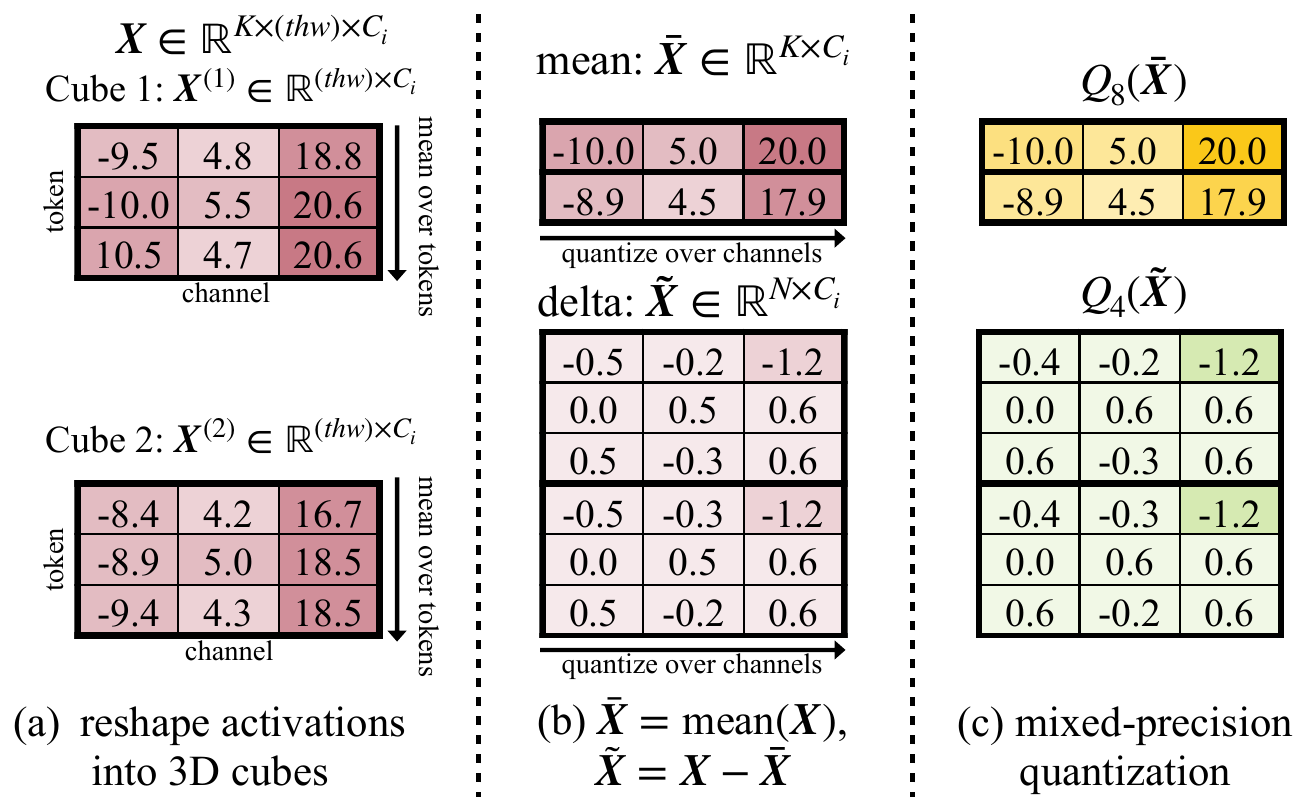
Video diffusion models have achieved remarkable generative performance, but their substantial computational and memory costs pose significant challenges for deployment, especially on consumer GPUs. As recent advances in attention optimization mitigate previous computational bottlenecks, linear layers now dominate both computational cost and inference memory. In this work, we focus on quantizing both weights and activations to 4 bits to accelerate these layers. Previous methods, such as SVDQuant, overlook the highly dynamic nature of activations across denoising timesteps, where outlier channels and magnitudes vary dramatically. However, video data inherently exhibits strong activation similarity among neighboring tokens in space and time, which we term spatiotemporal activation similarity, analogous to how video codecs exploit intra- and inter-frame redundancy. Leveraging this property, we introduce DeltaQuant, which partitions activations into local 3D spatiotemporal cubes and uses each cube's mean token as a core token, quantizing only the small differences (delta tokens) to 4 bits while keeping core tokens in FP8. This decomposition substantially reduces quantization error with minimal overhead. For weight quantization, DeltaQuant incorporates SVDQuant's low-rank decomposition to further reduce quantization error. We also implement an efficient kernel that translates DeltaQuant's computational benefits into real-world speedups. Extensive experiments on Wan 2.2 I2V, Wan 2.2 T2V, and LTX-Video T2V demonstrate that DeltaQuant maintains high generation fidelity. On Wan 2.2, it compresses model size by 2.9x and reduces memory footprint by 2.3x. DeltaQuant is compatible with efficient attention mechanisms and few-step distillation. When integrated with these techniques, it achieves an additional 3.0x acceleration, for a total 111.8x end-to-end speedup. Code and models will be released upon publication.
A 4-bit weight-activation quantization method for video diffusion models that exploits spatiotemporal activation similarity, compressing Wan 2.2 by 2.9× and cutting memory by 2.3×.
We actively collaborate with industry partners on efficient AI, model compression and acceleration. Our research has influenced and landed in many industrial products: Intel OpenVino, Intel Neural Network Distiller, Intel Neural Compressor, Apple Neural Engine, NVIDIA Sparse Tensor Core, NVIDIA TensorRT LLM, AMD-Xilinx Vitis AI, Qualcomm AI Model Efficiency Toolkit (AIMET), Amazon AutoGluon, Facebook PyTorch, Microsoft NNI, SONY Neural Architecture Search Library, SONY Model Compression Toolkit, ADI MAX78000/MAX78002 Model Training and Synthesis Tool.


