
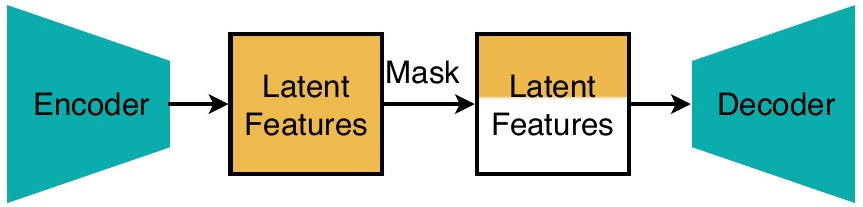
We present DC-AE 1.5, a new family of deep compression autoencoders for high-resolution diffusion models. Increasing the autoencoder's latent channel number is a highly effective approach for improving its reconstruction quality. However, it results in slow convergence for diffusion models, leading to poorer generation quality despite better reconstruction quality. This issue limits the quality upper bound of latent diffusion models and hinders the employment of autoencoders with higher spatial compression ratios. We introduce two key innovations to address this challenge: i) Structured Latent Space, a training-based approach to impose a desired channel-wise structure on the latent space with front latent channels capturing object structures and the latter latent channels capturing image details; ii) Augmented Diffusion Training, an augmented diffusion training strategy with additional diffusion training objectives on object latent channels to accelerate convergence. With these techniques, DC-AE 1.5 delivers faster convergence and better diffusion scaling results than DC-AE. On ImageNet 512x512, DC-AE-1.5-f64c128 delivers better image generation quality than DC-AE-f32c32 while being 4x faster.
We present DC-AE 1.5, a new family of deep compression autoencoders to accelerate diffusion model convergence with structured latent space.
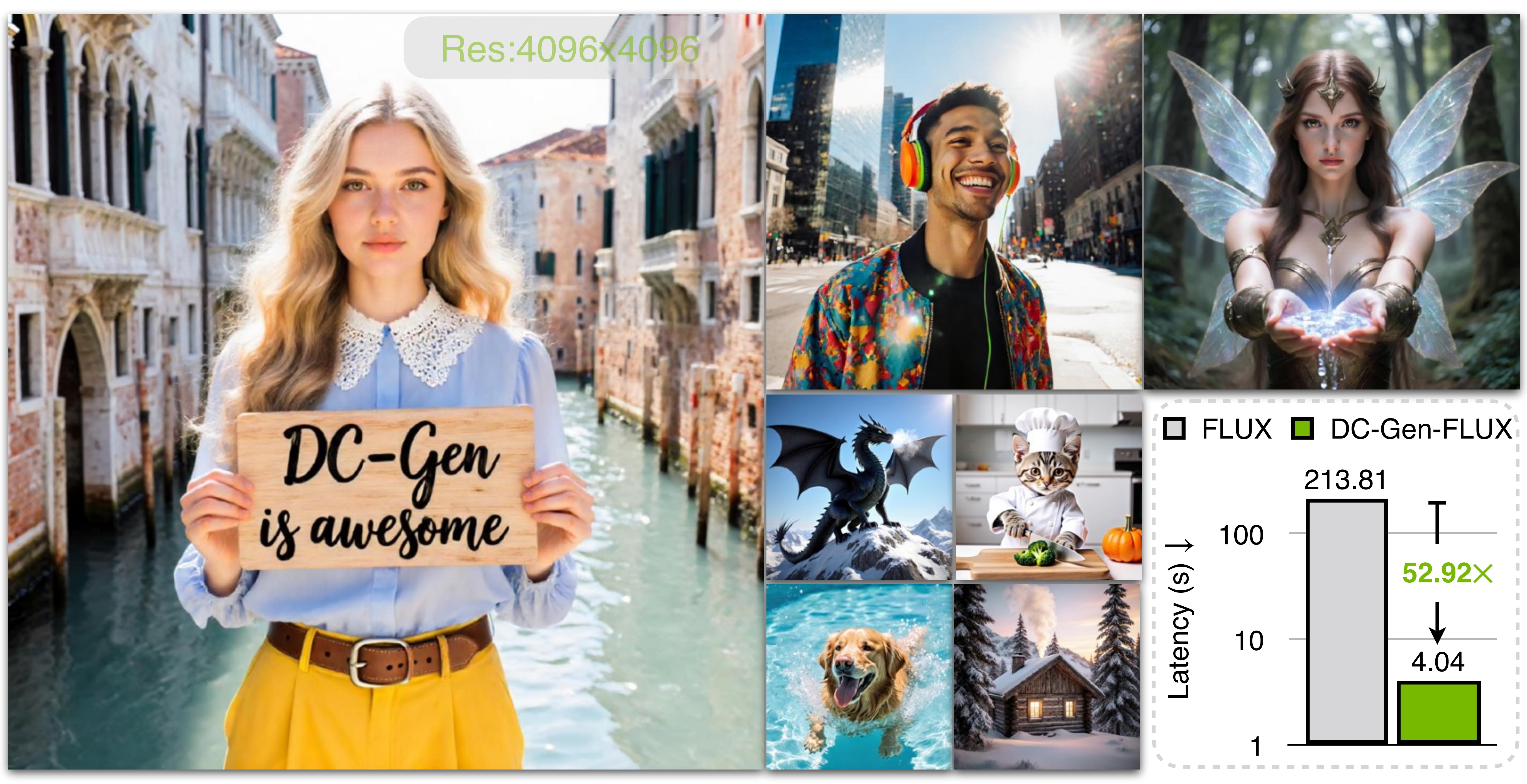
Existing text-to-image diffusion models excel at generating high-quality images, but face significant efficiency challenges when scaled to high resolutions, like 4K image generation. While previous research accelerates diffusion models in various aspects, it seldom handles the inherent redundancy within the latent space. To bridge this gap, this paper introduces DC-Gen, a general framework that accelerates text-to-image diffusion models by leveraging a deeply compressed latent space. Rather than a costly training-from-scratch approach, DC-Gen uses an efficient post-training pipeline to preserve the quality of the base model. A key challenge in this paradigm is the representation gap between the base model’s latent space and a deeply compressed latent space, which can lead to instability during direct fine-tuning. To overcome this, DC-Gen first bridges the representation gap with a lightweight embedding alignment training. Once the latent embeddings are aligned, only a small amount of LoRA fine-tuning is needed to unlock the base model’s inherent generation quality. We verify DC-Gen’s effectiveness on SANA and FLUX.1-Krea. The resulting DC-Gen-SANA and DC-Gen-FLUX models achieve quality comparable to their base models but with a significant speedup. Specifically, DC-Gen-FLUX reduces the latency of 4K image generation by 53x on the NVIDIA H100 GPU. When combined with NVFP4 SVDQuant, DC-Gen-FLUX generates a 4K image in just 3.5 seconds on a single NVIDIA 5090 GPU, achieving a total latency reduction of 138x compared to the base FLUX.1-Krea model. Code and models will be released.
DC-Gen is a general post-training framework that accelerates pre-trained text-to-image diffusion models.
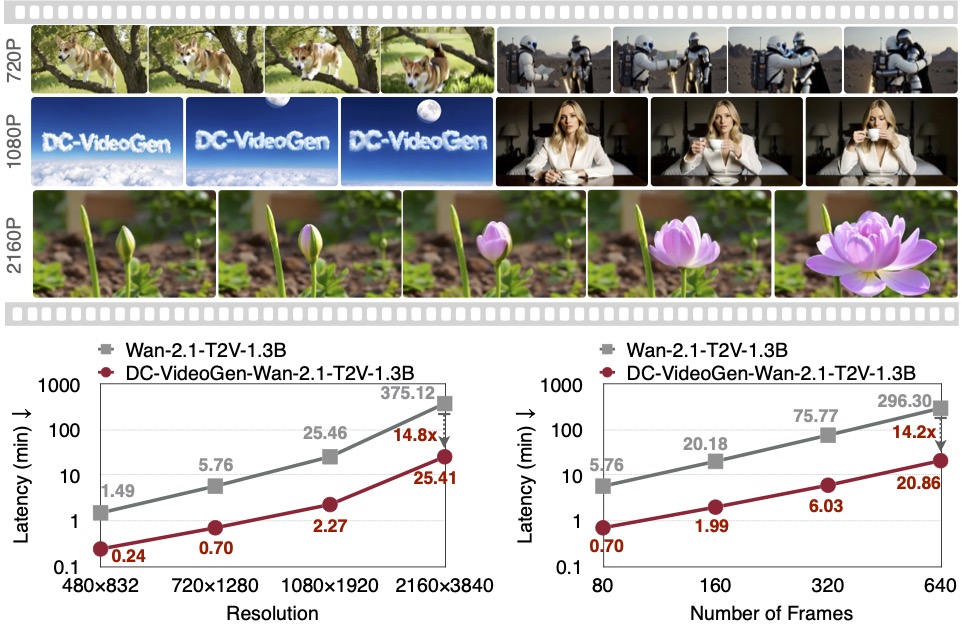
We introduce DC-VideoGen, a post-training acceleration framework for efficient video generation. DC-VideoGen can be applied to any pre-trained video diffusion model, improving efficiency by adapting it to a deep compression latent space with lightweight fine-tuning. The framework builds on two key innovations: (i) a Deep Compression Video Autoencoder with a novel chunk-causal temporal design that achieves 32x/64x spatial and 4x temporal compression while preserving reconstruction quality and generalization to longer videos; and (ii) AE-Adapt-V, a robust adaptation strategy that enables rapid and stable transfer of pre-trained models into the new latent space. Adapting the pre-trained Wan-2.1-14B model with DC-VideoGen requires only 10 GPU days on the NVIDIA H100 GPU. The accelerated models achieve up to 14.8x lower inference latency than their base counterparts without compromising quality, and further enable 2160x3840 video generation on a single GPU.
We introduce DC-VideoGen, a post-training acceleration framework for efficient video generation with a Deep Compression Video Autoencoder and a robust adapation strategy AE-Adapt-V.
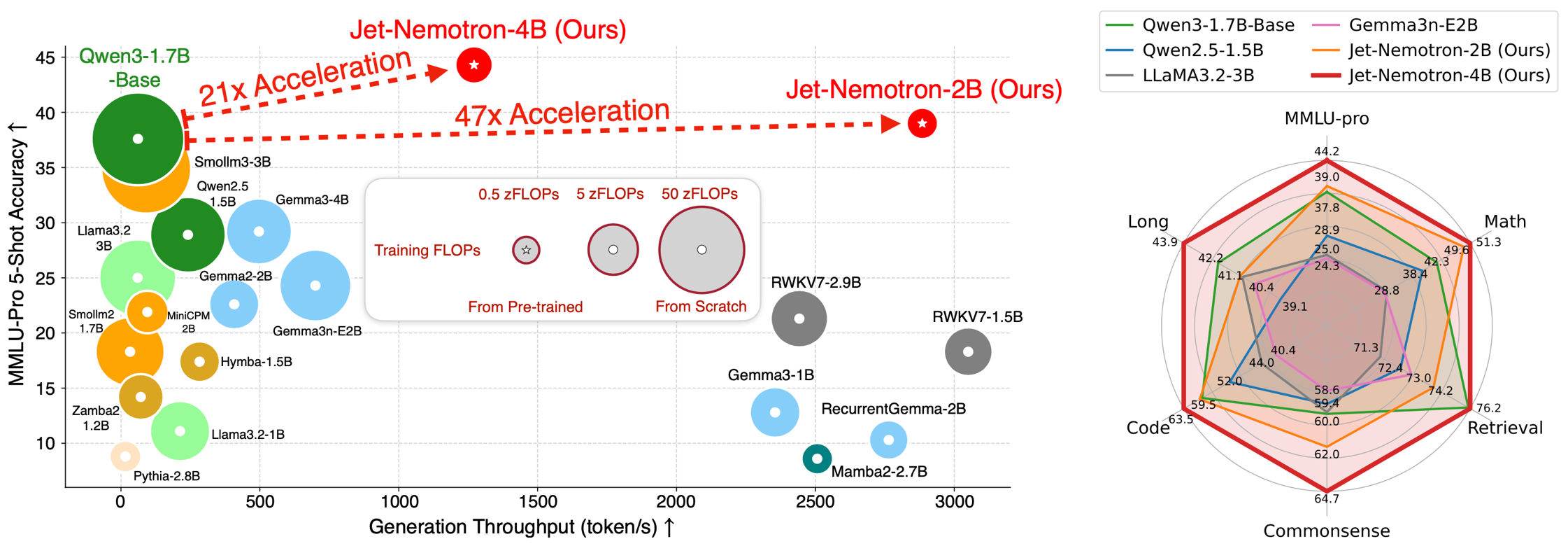
We present Jet-Nemotron, a new family of hybrid-architecture language models, which matches or exceeds the accuracy of leading full-attention models while significantly improving generation throughput. Jet-Nemotron is developed using Post Neural Architecture Search (PostNAS), a novel neural architecture exploration pipeline that enables efficient model design. Unlike prior approaches, PostNAS begins with a pre-trained full-attention model and freezes its MLP weights, allowing efficient exploration of attention block designs. The pipeline includes four key components: (1) learning optimal full-attention layer placement and elimination, (2) linear attention block selection, (3) designing new attention blocks, and (4) performing hardware-aware hyperparameter search. Our Jet-Nemotron-2B model achieves comparable or superior accuracy to Qwen3, Qwen2.5, Gemma3, and Llama3.2 across a comprehensive suite of benchmarks while delivering up to 53.6× generation throughput speedup and 6.1× prefilling speedup.
Jet-Nemotron is a family of hybrid models leveraging both full and linear attention, offering accuracy on par with leading full-attention LMs like Qwen3, LLama3.2, and Gemma3n. Jet-Nemotron-2B provides a 47x generation throughput speedup under a 64K context length compared to Qwen3-1.7B-Base, achieving top-tier accuracy with exceptional efficiency.


