
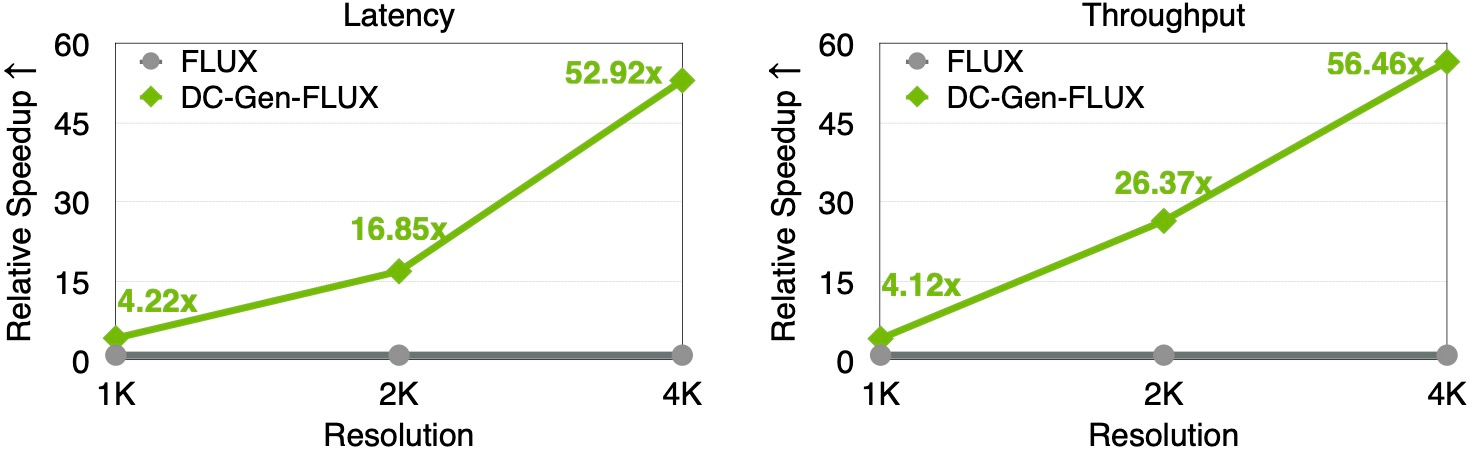
Existing text-to-image diffusion models excel at generating high-quality images, but face significant efficiency challenges when scaled to high resolutions, like 4K image generation. While previous research accelerates diffusion models in various aspects, it seldom handles the inherent redundancy within the latent space. To bridge this gap, this paper introduces DC-Gen, a general framework that accelerates text-to-image diffusion models by leveraging a deeply compressed latent space. Rather than a costly training-from-scratch approach, DC-Gen uses an efficient post-training pipeline to preserve the quality of the base model. A key challenge in this paradigm is the representation gap between the base model’s latent space and a deeply compressed latent space, which can lead to instability during direct fine-tuning. To overcome this, DC-Gen first bridges the representation gap with a lightweight embedding alignment training. Once the latent embeddings are aligned, only a small amount of LoRA fine-tuning is needed to unlock the base model’s inherent generation quality. We verify DC-Gen’s effectiveness on SANA and FLUX.1-Krea. The resulting DC-Gen-SANA and DC-Gen-FLUX models achieve quality comparable to their base models but with a significant speedup. Specifically, DC-Gen-FLUX reduces the latency of 4K image generation by 53x on the NVIDIA H100 GPU. When combined with NVFP4 SVDQuant, DC-Gen-FLUX generates a 4K image in just 3.5 seconds on a single NVIDIA 5090 GPU, achieving a total latency reduction of 138x compared to the base FLUX.1-Krea model. Code and models will be released.
DC-Gen is a new acceleration framework for diffusion models. DC-Gen works with any pre-trained diffusion model, boosting efficiency by transferring it into a deeply compressed latent space with lightweight post-training. For example, applying DC-Gen to FLUX.1-Krea-12B takes just 40 H100 GPU days. The resulting DC-Gen-FLUX delivers the same quality as the base model while achieving dramatic gains—53× faster inference on H100 at 4K resolution. And when paired with NVFP4, DC-Gen-FLUX (20 sampling steps) generates a 4K image in only 3.5 seconds on a single NVIDIA 5090 GPU, a total latency reduction of 138× compared to the base FLUX.1-Krea model.


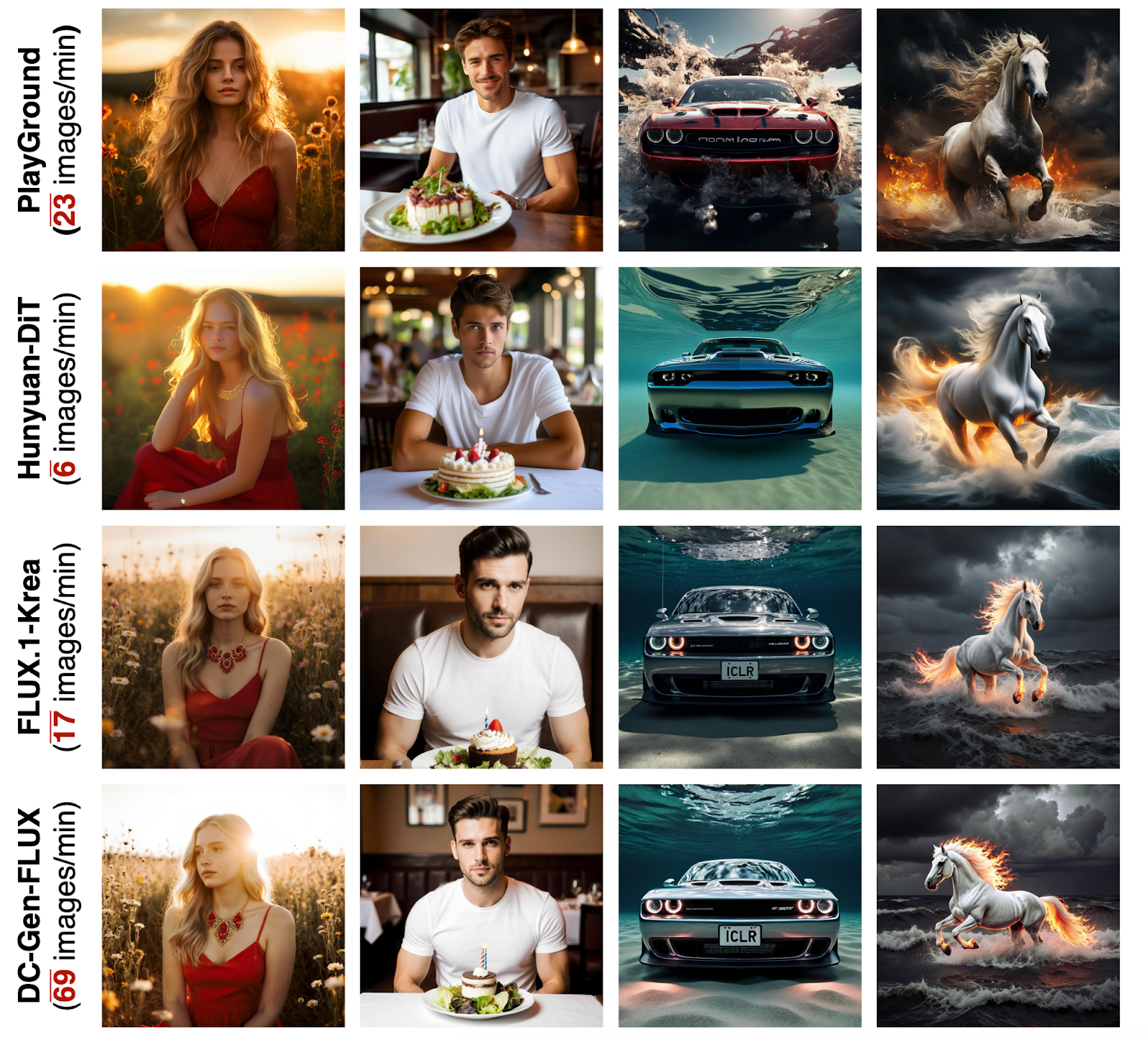
FLUX.1-Krea is recognized for its superior realism and text-rendering capabilities but suffers from lower throughput. DC-Gen-FLUX successfully preserves these qualities while delivering a significant speedup over FLUX.1-Krea, achieving the highest throughput among the models compared.
Previously, changing the autoencoder required retraining diffusion models from scratch, which was highly inefficient. DC-Gen introduces Embedding Alignment to transfer the base model’s knowledge to the new latent space. After this alignment, the model can generate images with correct semantics in the new latent space without finetuning the diffusion model’s weights.

Following embedding alignment, we can fully recover the quality through LoRA finetuning.

@article{he2025dc,
title={DC-Gen: Post-Training Diffusion Acceleration with Deeply Compressed Latent Space},
author={He, Wenkun and Gu, Yuchao and Chen, Junyu and Zou, Dongyun and Lin, Yujun and Zhang, Zhekai and Xi, Haocheng and Li, Muyang and Zhu, Ligeng and Yu, Jincheng and others},
journal={arXiv preprint arXiv:2509.25180},
year={2025}
}


