

We introduce a full-stack framework that scales up reasoning in vision-language models (VLMs) to long videos, leveraging reinforcement learning. We address the unique challenges of long video reasoning by integrating three critical components: (1) a large-scale dataset, LongVideo-Reason, comprising 104K long video QA pairs with high-quality reasoning annotations across diverse domains such as sports, games, and vlogs; (2) a two-stage training pipeline that extends VLMs with chain-of-thought supervised fine-tuning (CoT-SFT) and reinforcement learning (RL); and (3) a training infrastructure for long video RL, named Multi-modal Reinforcement Sequence Parallelism (MR-SP), which incorporates sequence parallelism and a vLLM-based engine tailored for long video, using cached video embeddings for efficient rollout and prefilling. In our experiments, LongVILA-R1-7B achieves strong performance on video benchmarks, reaching 65.1% and 71.1% accuracy on VideoMME without and with subtitles, respectively, and consistently outperforming LongVILA-7B across multiple benchmarks. Moreover, LongVILA-R1-7B supports processing up to 8,192 video frames per video, and configurable FPS settings. Notably, our MR-SP system achieves up to 2.1x speedup on long video RL training. In addition, we release our training system for public availability that supports RL training on various modalities (video, text, and audio), various models (VILA and Qwen series), and even image and video generation models. On a single A100 node (8 GPUs), it supports RL training on hour-long videos (e.g., 3,600 frames).
Long-RL enables RL on hour-long videos on a single A100; LongVILA-R1-7B supports 8,192 frames and scores 71.1% on VideoMME with subtitles.

Recent advances in diffusion models have enabled high-quality video generation, but the additional temporal dimension significantly increases computational costs, making training and inference on long videos prohibitively expensive. In this paper, we identify a phenomenon we term Spatiotemporal Energy Decay in video diffusion models: post-softmax attention scores diminish as spatial and temporal distance between tokens increase, akin to the physical decay of signal or waves over space and time in nature. Motivated by this, we propose Radial Attention, a scalable sparse attention mechanism with O(nlogn) complexity that translates energy decay into exponentially decaying compute density, which is significantly more efficient than standard O(n2) dense attention and more expressive than linear attention. Specifically, Radial Attention employs a simple, static attention mask where each token attends to spatially nearby tokens, with the attention window size shrinking with temporal distance. Moreover, it allows pre-trained video diffusion models to extend their generation length with efficient LoRA-based fine-tuning. Extensive experiments show that Radial Attention maintains video quality across Wan2.1-14B, HunyuanVideo, and Mochi 1, achieving up to a 1.9× speedup over the original dense attention. With minimal tuning, it enables video generation up to 4× longer while reducing training costs by up to 4.4× compared to direct fine-tuning and accelerating inference by up to 3.7× compared to dense attention inference.
A O(nlogn) Sparse Attention Mask for Long Video Generation
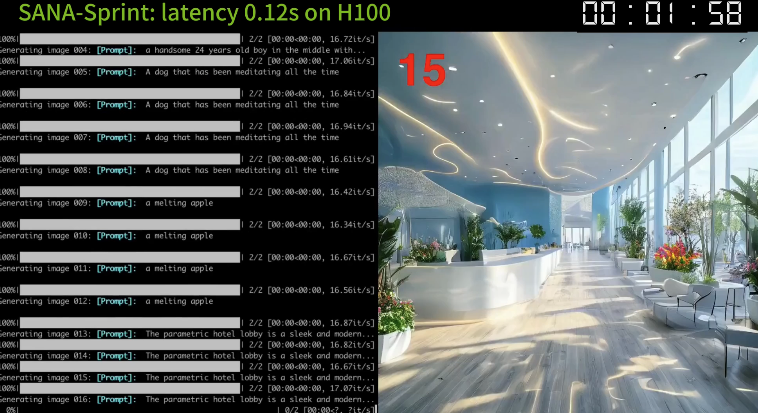
This paper presents SANA-Sprint, an efficient diffusion model for ultra-fast text-to-image (T2I) generation. SANA-Sprint is built on a pre-trained foundation model and augmented with hybrid distillation, dramatically reducing inference steps from 20 to 1-4. We introduce three key innovations: (1) We propose a training-free approach that transforms a pre-trained flow-matching model for continuous-time consistency distillation (sCM), eliminating costly training from scratch and achieving high training efficiency. Our hybrid distillation strategy combines sCM with latent adversarial distillation (LADD): sCM ensures alignment with the teacher model, while LADD enhances single-step generation fidelity. (2) SANA-Sprint is a unified step-adaptive model that achieves high-quality generation in 1-4 steps, eliminating step-specific training and improving efficiency. (3) We integrate ControlNet with SANA-Sprint for real-time interactive image generation, enabling instant visual feedback for user interaction. SANA-Sprint establishes a new Pareto frontier in speed-quality tradeoffs, achieving state-of-the-art performance with 7.59 FID and 0.74 GenEval in only 1 step — outperforming FLUX-schnell (7.94 FID / 0.71 GenEval) while being 10× faster (0.1s vs 1.1s on H100). It also achieves 0.1s (T2I) and 0.25s (ControlNet) latency for 1024×1024 images on H100, and 0.31s (T2I) on an RTX 4090, showcasing its exceptional efficiency and potential for AI-powered consumer applications (AIPC). Code and pre-trained models will be open-sourced.
SANA-Sprint is a one-step distilled diffusion model enabling real-time generation; Deployable on laptop GPU; Top-notch GenEval & DPGBench results.

We introduce DC-AR, a novel masked autoregressive (AR) text-to-image generation framework that delivers superior image generation quality with exceptional computational efficiency. Due to the tokenizers' limitations, prior masked AR models have lagged behind diffusion models in terms of quality or efficiency. We overcome this limitation by introducing DC-HT— a deep compression hybrid tokenizer for AR models that achieves a 32x spatial compression ratio while maintaining high reconstruction fidelity and cross-resolution generalization ability. Building upon DC-HT, we extend MaskGIT and create a new hybrid masked autoregressive image generation framework that first produces the structural elements through discrete tokens and then applies refinements via residual tokens. DC-AR achieves state-of-the-art results with a gFID of 5.49 on MJHQ-30K and an overall score of 0.69 on GenEval, while offering 1.5-7.9x higher throughput and 2.0-3.5x lower latency compared to prior leading diffusion and masked autoregressive models.
DC-AR is a high-efficiency masked AR framework for text-to-image generation, leveraging DC-HT—a hybrid tokenizer enabling 32x compression. It refines images via residual tokens, achieving remarkable results with 1.5–7.9x faster throughput and 2–3.5x lower latency than other leading models.


