
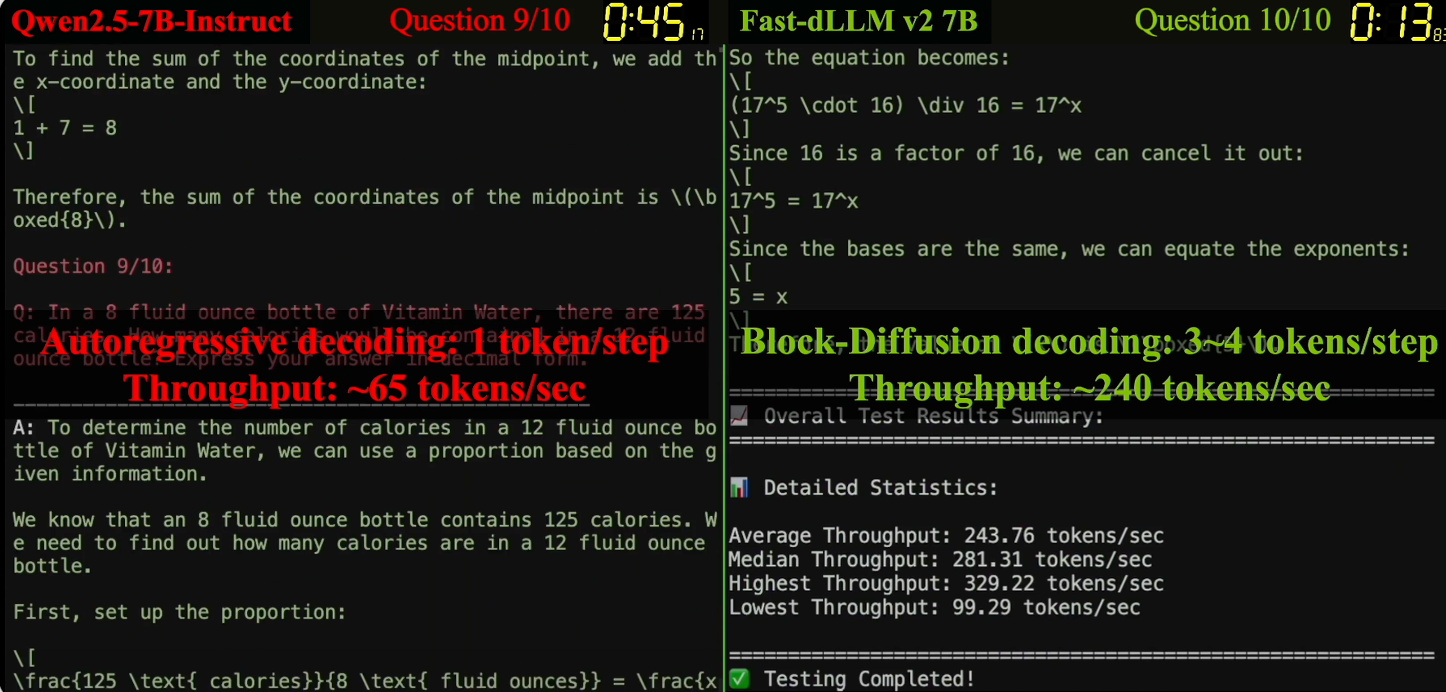
Autoregressive (AR) large language models (LLMs) have achieved remarkable performance across a wide range of natural language tasks, yet their inherent sequential decoding limits inference efficiency. In this work, we propose Fast-dLLM v2, a carefully designed block diffusion language model (dLLM) that efficiently adapts pretrained AR models into dLLMs for parallel text generation, requiring only approximately 1B tokens of fine-tuning. This represents a 500x reduction in training data compared to full-attention diffusion LLMs such as Dream (580B tokens), while preserving the original model's performance. Our approach introduces a novel training recipe that combines a block diffusion mechanism with a complementary attention mask, enabling blockwise bidirectional context modeling without sacrificing AR training objectives. To further accelerate decoding, we design a hierarchical caching mechanism: a block-level cache that stores historical context representations across blocks, and a sub-block cache that enables efficient parallel generation within partially decoded blocks. Coupled with our parallel decoding pipeline, Fast-dLLM v2 achieves up to 2.5x speedup over standard AR decoding without compromising generation quality. Extensive experiments across diverse benchmarks demonstrate that Fast-dLLM v2 matches or surpasses AR baselines in accuracy, while delivering state-of-the-art efficiency among dLLMs - marking a significant step toward the practical deployment of fast and accurate LLMs.
Our approach introduces a novel training recipe that combines a block diffusion mechanism with a complementary attention mask, enabling blockwise bidirectional context modeling without sacrificing AR training objectives.
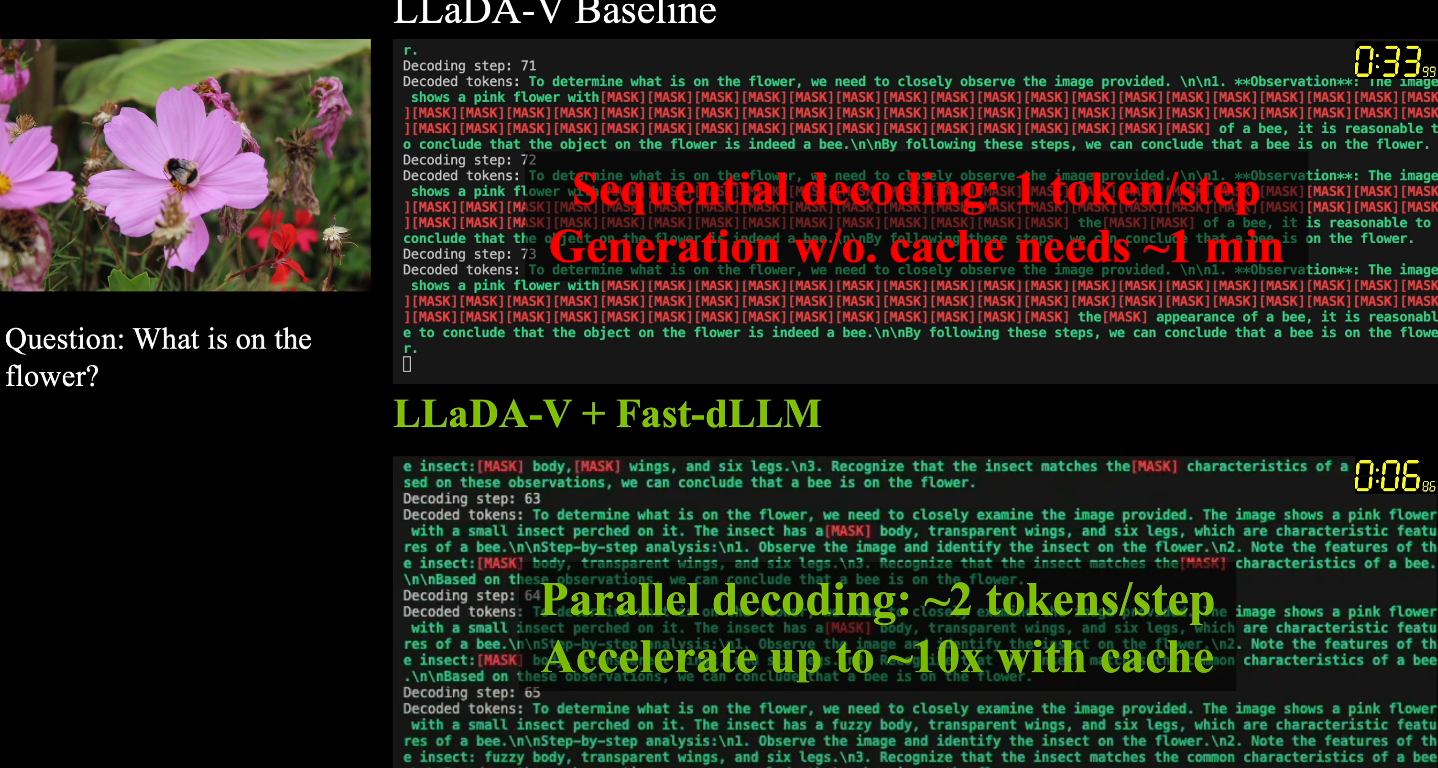
Diffusion-based large language models (Diffusion LLMs) have shown promise for non-autoregressive text generation with parallel decoding capabilities. However, the practical inference speed of open-sourced Diffusion LLMs often lags behind autoregressive models due to the lack of Key-Value (KV) Cache and quality degradation when decoding multiple tokens simultaneously. To bridge this gap, we introduce a novel block-wise approximate KV Cache mechanism tailored for bidirectional diffusion models, enabling cache reuse with negligible performance drop. Additionally, we identify the root cause of generation quality degradation in parallel decoding as the disruption of token dependencies under the conditional independence assumption. To address this, we propose a confidence-aware parallel decoding strategy that selectively decodes tokens exceeding a confidence threshold, mitigating dependency violations and maintaining generation quality. Experimental results on LLaDA and Dream models across multiple LLM benchmarks demonstrate up to 27.6x throughput improvement with minimal accuracy loss, closing the performance gap with autoregressive models and paving the way for practical deployment of Diffusion LLMs.
We introduce a novel block-wise approximate KV Cache mechanism tailored for bidirectional diffusion models, enabling cache reuse with negligible performance drop.
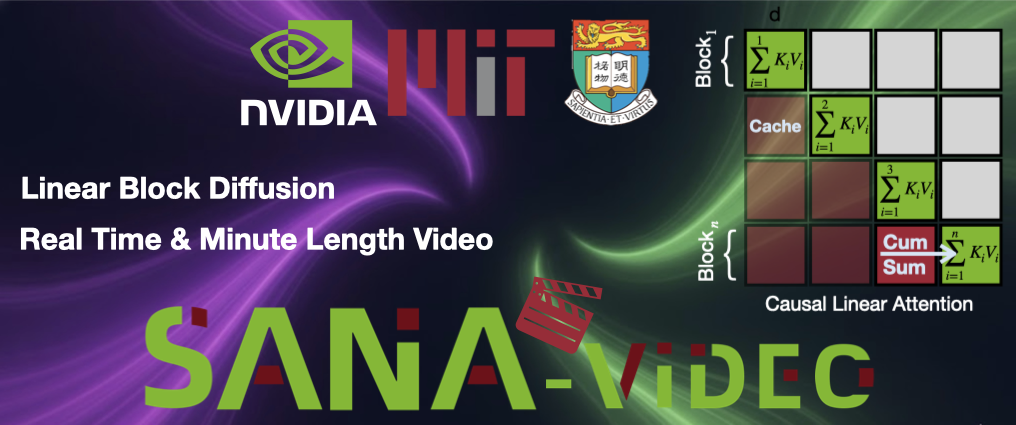
We introduce SANA-Video, a small diffusion model that can efficiently generate videos up to 720×1280 resolution and minute-length duration. SANA-Video synthesizes high-resolution, high-quality and long videos with strong text-video alignment at a remarkably fast speed, deployable on RTX 5090 GPU. Two core designs ensure our efficient, effective and long video generation: (1) Linear DiT: We leverage linear attention as the core operation, which is more efficient than vanilla attention given the large number of tokens processed in video generation. (2) Constant-Memory KV cache for Block Linear Attention: we design block-wise autoregressive approach for long video generation by employing a constant-memory state, derived from the cumulative properties of linear attention. This KV cache provides the Linear DiT with global context at a fixed memory cost, eliminating the need for a traditional KV cache and enabling efficient, minute-long video generation. In addition, we explore effective data filters and model training strategies, narrowing the training cost to 12 days on 64 H100 GPUs, which is only 1% of the cost of MovieGen. Given its low cost, SANA-Video achieves competitive performance compared to modern state-of-the-art small diffusion models (e.g., Wan 2.1-1.3B and SkyReel-V2-1.3B) while being 16× faster in measured latency. Moreover, SANA-Video can be deployed on RTX 5090 GPUs with NVFP4 precision, accelerating the inference speed of generating a 5-second 720p video from 71s to 29s (2.4× speedup). In summary, SANA-Video enables low-cost, high-quality video generation. Code and model will be publicly released.
SANA-Video is a fast, efficient diffusion model that generates high-quality, minute-long videos upto 720×1280 resolution. It uses linear attention and a constant-memory KV cache to handle long videos with fixed memory, enabling real-time (27PFS) 1 mintue video generation.
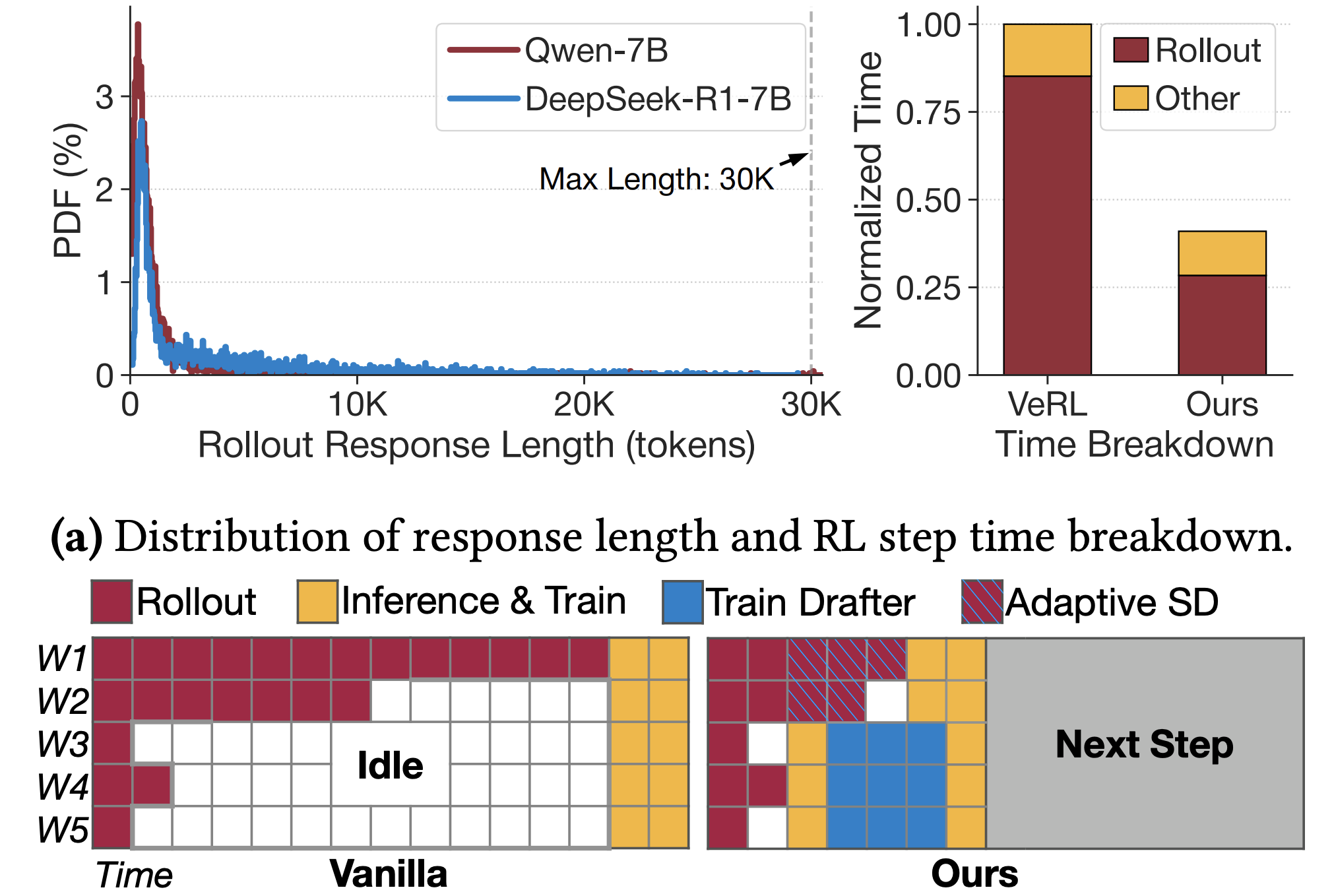
The emergence of Large Language Models (LLMs) with strong reasoning capabilities marks a significant milestone, unlocking new frontiers in complex problem-solving. However, training these reasoning models, typically using Reinforcement Learning (RL), encounters critical efficiency bottlenecks: response generation during RL training exhibits a persistent long-tail distribution, where a few very long responses dominate execution time, wasting resources and inflating costs. To address this, we propose TLT, a system that accelerates reasoning RL training losslessly by integrating adaptive speculative decoding. Applying speculative decoding in RL is challenging due to the dynamic workloads, evolving target model, and draft model training overhead. TLT overcomes these obstacles with two synergistic components: (1) Adaptive Drafter, a lightweight draft model trained continuously on idle GPUs during long-tail generation to maintain alignment with the target model at no extra cost; and (2) Adaptive Rollout Engine, which maintains a memory efficient pool of pre-captured CUDAGraphs and adaptively select suitable SD strategies for each input batch. Evaluations demonstrate that TLT achieves over 1.7× end-to-end RL training speedup over state-of-the-art systems, preserves the model accuracy, and yields a high-quality draft model as a free byproduct suitable for efficient deployment.
TLT is a lossless acceleration framework for reasoning-oriented LLM RL training, introducing adaptive speculative decoding to eliminate long-tail generation bottlenecks. It achieves over 1.7× end-to-end speedup while fully preserving model quality and producing a high-quality draft model for efficient deployment.


