
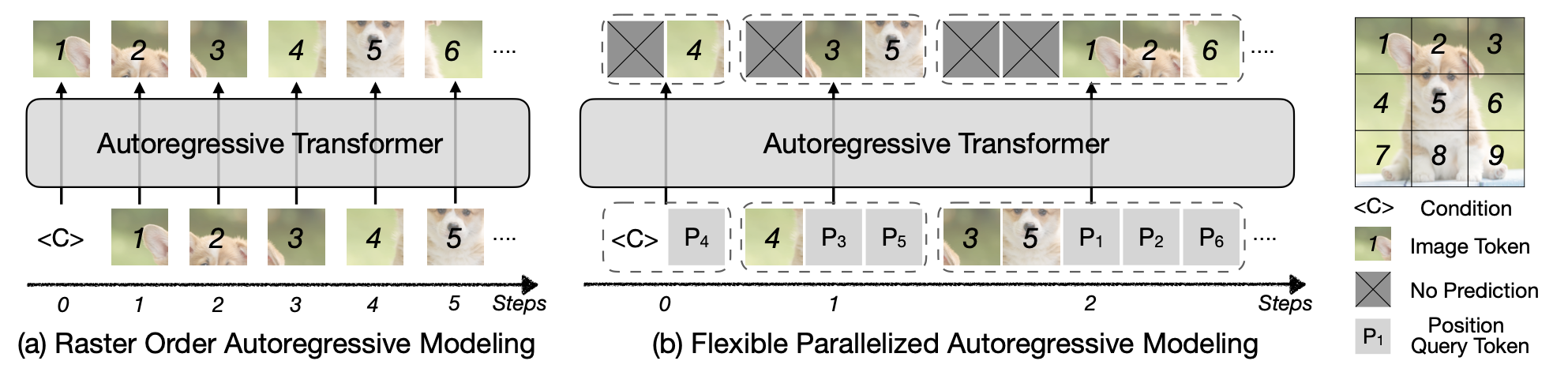
We present Locality-aware Parallel Decoding (LPD) to accelerate autoregressive image generation. Traditional autoregressive image generation relies on next-patch prediction, a memory-bound process that leads to high latency. Existing works have tried to parallelize next-patch prediction by shifting to multi-patch prediction to accelerate the process, but only achieved limited parallelization. To achieve high parallelization while maintaining generation quality, we introduce two key techniques: (1) Flexible Parallelized Autoregressive Modeling, a novel architecture that enables arbitrary generation ordering and degrees of parallelization. It uses learnable position query tokens to guide generation at target positions while ensuring mutual visibility among concurrently generated tokens for consistent parallel decoding. (2) Locality-aware Generation Ordering, a novel schedule that forms groups to minimize intra-group dependencies and maximize contextual support, enhancing generation quality. With these designs, we reduce the generation steps from 256 to 20 (256×256 res.) and 1024 to 48 (512×512 res.) without compromising quality on the ImageNet class-conditional generation, and achieving at least 3.4× lower latency than previous parallelized autoregressive models.
We introduce Locality-aware Parallel Decoding to accelerate autoregressive image generation and achieve 13× faster than traditional AR models and at least 3.4× faster than previous parallelized AR models.
Vision-language models (VLMs) could power real-time assistants and autonomous agents, but they face a critical challenge: understanding near-infinite video streams without escalating latency and memory usage. Processing entire videos with full attention leads to quadratic computational costs and poor performance on long videos. Meanwhile, simple sliding window methods are also flawed, as they either break coherence or suffer from high latency due to redundant recomputation. In this paper, we introduce StreamingVLM, a model designed for real-time, stable understanding of infinite visual input. Our approach is a unified framework that aligns training with streaming inference. During inference, we maintain a compact KV cache by reusing states of attention sinks, a short window of recent vision tokens, and a long window of recent text tokens. This streaming ability is instilled via a simple supervised fine-tuning (SFT) strategy that applies full attention on short, overlapped video chunks, which effectively mimics the inference-time attention pattern without training on prohibitively long contexts. For evaluation, we build Inf-Streams-Eval, a new benchmark with videos averaging over two hours that requires dense, per-second alignment between frames and text. On Inf-Streams-Eval, StreamingVLM achieves a 66.18% win rate against GPT-4o mini and maintains stable, real-time performance at up to 8 FPS on a single NVIDIA H100.
StreamingVLM enables real-time understanding of infinite videos with low, stable latency. By aligning training on overlapped video chunks with an efficient KV cache, it runs at 8 FPS on a single H100. It achieves a 66.18% win rate vs. GPT-4o mini on a new benchmark with videos averaging over 2 hours long.

We present LongLive, a frame-level autoregressive (AR) framework for real-time and interactive long video generation. Long video generation presents challenges in both efficiency and quality. Diffusion and Diffusion-Forcing models can produce high-quality videos but suffer from low efficiency due to bidirectional attention. Causal attention AR models support KV caching for faster inference, but often degrade in quality on long videos due to memory challenges during long-video training. In addition, beyond static prompt-based generation, interactive capabilities, such as streaming prompt inputs, are critical for dynamic content creation, enabling users to guide narratives in real time. This interactive requirement significantly increases complexity, especially in ensuring visual consistency and semantic coherence during prompt transitions. To address these challenges, LongLive adopts a causal, frame-level AR design that integrates a KV-recache mechanism that refreshes cached states with new prompts for smooth, adherent switches; streaming long tuning to enable long video training and to align training and inference (train-long-test-long); and short window attention paired with a frame-level attention sink, shorten as frame sink, preserving long-range consistency while enabling faster generation. With these key designs, LongLive fine-tunes a 1.3B-parameter short-clip model to minute-long generation in just 32 GPU-days. At inference, LongLive sustains 20.7 FPS on a single NVIDIA H100, achieves strong performance on VBench in both short and long videos. LongLive supports up to 240-second videos on a single H100 GPU. LongLive further supports INT8-quantized inference with only marginal quality loss.
We present LongLive, a frame-level autoregressive (AR) framework for real-time and interactive long video generation. Try LongLive: turning your interactive prompts into long videos-instantly, as you type!

We propose QeRL, a Quantization-enhanced Reinforcement Learning framework for large language models (LLMs). While RL is essential for LLMs' reasoning capabilities, it is resource-intensive, requiring substantial GPU memory and long rollout durations. QeRL addresses these issues by combining NVFP4 quantization with Low-Rank Adaptation (LoRA), accelerating rollout phase of RL while reducing memory overhead. Beyond efficiency, our findings show that quantization noise increases policy entropy, enhancing exploration, and enabling the discovery of better strategies during RL. To further optimize exploration, QeRL introduces an Adaptive Quantization Noise (AQN) mechanism, which dynamically adjusts noise during training. Experiments demonstrate that QeRL delivers over 1.5 times speedup in the rollout phase. Moreover, this is the first framework to enable RL training of a 32B LLM on a single H100 80GB GPU, while delivering overall speedups for RL training. It also achieves faster reward growth and higher final accuracy than 16-bit LoRA and QLoRA, while matching the performance of full-parameter fine-tuning on mathematical benchmarks such as GSM8K (90.8%) and MATH 500 (77.4%) in the 7B model. These results establish QeRL as an efficient and effective framework for RL training in LLMs.
QeRL is a framework that accelerates LLM training by combining NVFP4 quantization with LoRA. It reduces memory overhead, allows 32B model training on a single H100 GPU, and improves performance by leveraging quantization noise to


